


INTRODUCTION
Inflammatory bowel disease (IBD) encompasses Crohn’s disease (CD) and ulcerative colitis (UC). Unlike UC, which typically involves only the colon, CD can affect any part of the gastrointestinal tract—from the mouth to the anus— and is characterized by chronic intestinal inflammation with alternating periods of relapse and remission, usually beginning in young adulthood [1]. According to the 2020 IBD Fact Sheet in Korea, the incidence and prevalence of CD in 2019 were 3.8 per 100,000 and 36.9 per 100,000, respectively, which are less than half of those reported for UC [2]. However, the incidence of CD in Korea is relatively high among Asian countries [3] and has gradually increased over the past 30 years [4]. Small bowel involvement in CD includes either isolated ileal (L1) or ileocolonic (L3) disease and accounts for approximately 70% of patients with CD. This rate is notably higher in Asian countries than in Western populations, whereas isolated colonic involvement (L2) is relatively uncommon in Korea [4,5]. Isolated ileal disease occurs in approximately 30% of patients with CD and may lead to delayed diagnosis due to normal colonoscopic findings and the difficulty of evaluating the small bowel. Distinct epidemiologic and pathogenic differences between ileal-dominant and isolated colonic CD have been reported, suggesting the need for a more refined disease classification [6]. Early detection and appropriate management of small bowel CD are crucial, as complications such as strictures (B2) and fistulas (B3) occur more frequently in ileal than in colonic CD, leading to difficult-to-treat conditions and an increased healthcare burden [1,6]. Moreover, small bowel CD is associated with an elevated risk of small bowel adenocarcinoma, which is often difficult to diagnose preoperatively [7]. In this review, we discuss the current diagnostic and therapeutic approaches for small bowel CD and explore future directions for its management.
PATHOGENESIS OF SMALL BOWEL CD
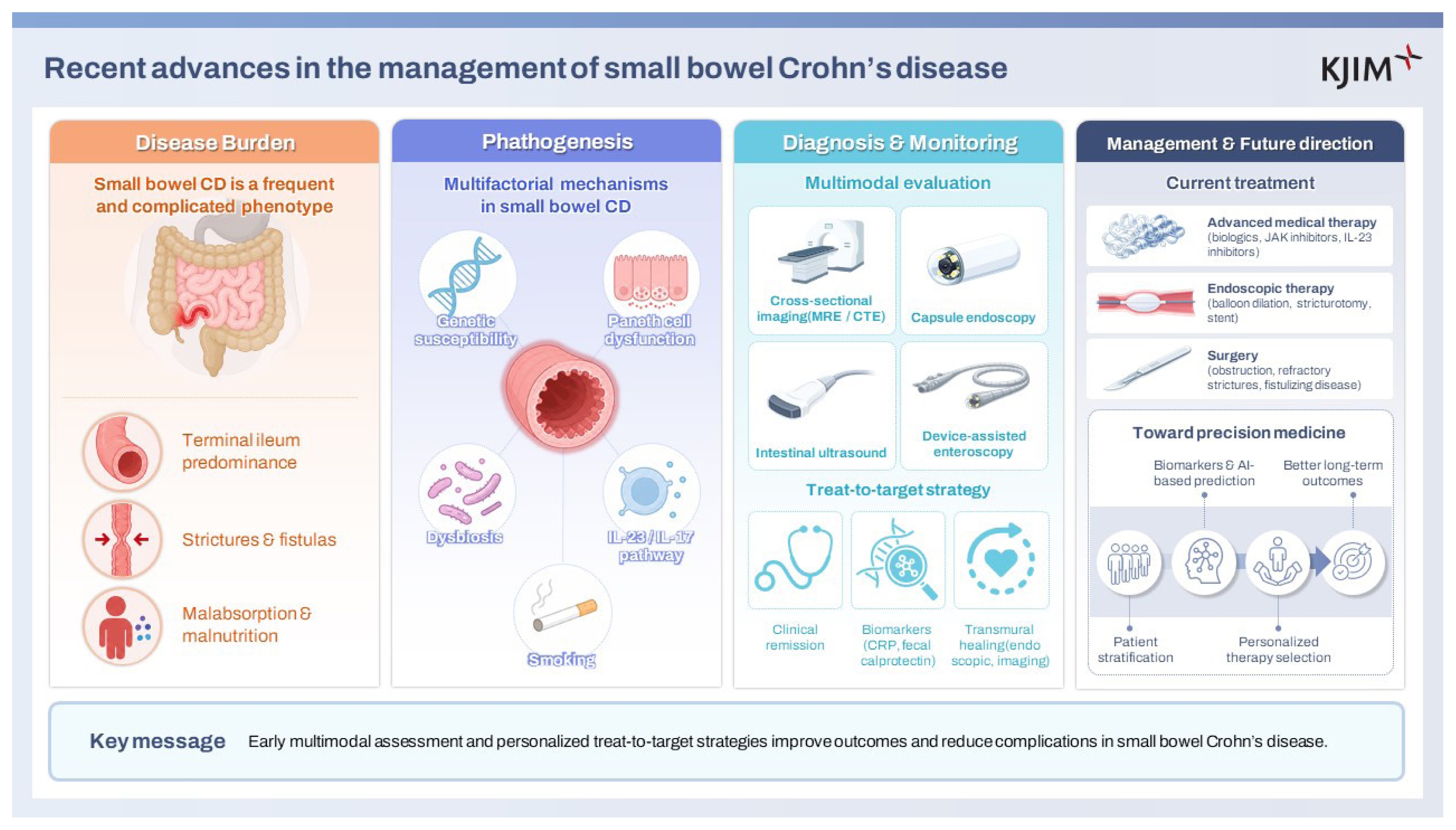
The pathogenesis of small bowel CD is considered multifactorial, involving genetic, environmental, microbial, and immunologic factors. The small bowel is the principal site for digestion and nutrient absorption. In particular, the terminal ileum—responsible for the uptake of vitamin B12, vitamin K, and bile acids—is the most commonly affected segment in small bowel CD. Consequently, small bowel CD is more frequently associated with malnutrition and malabsorptive disorders than isolated colonic CD. Paneth cell depletion and dysfunction are recognized as key contributors to the pathogenesis of small bowel CD. Genetically, susceptibility variants in NOD2 (formerly known as CARD15) and ATG16L1 are major abnormalities linked to the stricturing phenotype [8,9]. Furthermore, overactivation of the IL-23/IL-17 pathway is more prominent in small bowel CD than in colonic CD, promoting chronic intestinal inflammation [10]. Dysbiosis is also frequently implicated in small bowel CD, and smoking is a well-established aggravating factor.
DIAGNOSIS AND MONITORING OF SMALL BOWEL CD
In patients presenting with suspected symptoms such as chronic abdominal pain, bowel obstruction, restrictive eating patterns, anemia, and weight loss, small bowel evaluation should be considered during the diagnostic workup. However, these symptoms are nonspecific and often lead to delayed diagnosis. Moreover, approximately 50% of isolated small bowel CD cases cannot be detected by ileocolonoscopy. Therefore, when small bowel CD is suspected, prompt imaging assessment is essential (Table 1).
Assessment of structural small bowel damage using computed tomography enterography (CTE) or magnetic resonance enterography (MRE) enables precise detection of transmural inflammation and related complications. The diagnostic performance of both modalities is comparable; however, CTE exposes patients to significant radiation, whereas MRE is more time-consuming and less accessible because of its higher cost [11]. Recently, intestinal ultrasound (IUS) has emerged as a valuable imaging tool for assessing and monitoring IBD activity. IUS offers several advantages, including real-time, noninvasive, and radiation-free evaluation. It demonstrates diagnostic accuracy comparable to that of CTE, MRE, and ileocolonoscopy [12], and IUS findings strongly correlate with capsule endoscopy (CE)-based Lewis scores in active small bowel CD [13]. Additionally, advanced imaging techniques such as contrast-enhanced ultrasound, strain elastography, and shear wave elastography have been developed, allowing differentiation between inflammatory and fibrotic strictures [14].
Endoscopic detection with pathological confirmation is essential for the diagnosis of CD. Aphthous or linear ulcers with a discontinuous distribution throughout the gastrointestinal tract—from the mouth to the anus—are typical findings of CD. In severe cases, transmural ulcers, a cobblestone appearance, strictures, and fissures may also be observed. The ileocecal region is the most commonly affected site. Histopathologically, transmural and discontinuous inflammation are characteristic findings, and the presence of noncaseating granulomas is considered a hallmark feature of CD, although they are detected in only approximately 30% of cases [11,15]. For the evaluation of small bowel CD proximal to the terminal ileum, device-assisted enteroscopy (DAE) is used for confirmatory diagnosis [16]. DAE enables detailed visualization and tissue sampling; however, it is an invasive procedure and may not be suitable for patients with poor clinical status. Moreover, according to recent European Crohn’s and Colitis Organisation (ECCO) guidelines, DAE is not recommended as a first-line diagnostic tool for CD [11] (Table 1). The diagnostic performance and complication rates of DAE are comparable between single-balloon and double-balloon enteroscopy [17].
In selected patients with CD, CE is a valuable tool for diagnosis, particularly in cases of early or isolated small bowel CD [18]. CE has demonstrated a higher diagnostic yield for the detection and monitoring of small bowel CD compared with other diagnostic modalities [19]. In a previous multi-center case–control study conducted in Korea, a small proportion of patients with CD (0.6%) were diagnosed solely based on CE findings, despite negative results on ileocolonoscopy, CTE, or MRE. These patients exhibited a relatively benign disease course during follow-up [20]. Moreover, CE-guided monitoring and management have been associated with improved treatment outcomes [21]. Recent ECCO and American College of Gastroenterology guidelines also recommend CE as a useful adjunctive diagnostic tool for small bowel CD [7,11] (Table 1). However, capsule retention remains the most concerning complication of CE; therefore, a patency capsule should be used, particularly in patients with obstructive symptoms [22].
Patients with small bowel CD who achieve transmural healing demonstrate superior clinical outcomes, including lower rates of corticosteroid use, hospitalization, and surgery. Therefore, transmural healing has become a central therapeutic target in CD management. The STRIDE II consensus defines treatment objectives across different timeframes— short-term, intermediate-term, and long-term— and emphasizes deep remission, which includes clinical, biochemical, endoscopic, and transmural healing, as a key determinant of improved patient prognosis [23]. Effective monitoring of small bowel CD requires a combination of noninvasive and invasive assessment methods, including cross-sectional imaging, endoscopy, and inflammatory biomarkers [24]. In the treat-to-target strategy, initial therapy is selected according to disease severity, prognostic risk factors, and therapeutic goals. Reassessment is recommended within 6–12 weeks. If the target is achieved, regular evaluation of disease activity using both noninvasive and invasive tools every 6–12 months is advised. If the target is not achieved, treatment adjustment followed by reassessment every 3–6 months is recommended [25]. Fecal calprotectin (FC) correlates strongly with colonic inflammation in CD and UC. Several studies have also demonstrated a positive association between FC levels and endoscopic disease activity in small bowel CD [26,27]. However, the correlation between FC levels and small bowel inflammation remains uncertain and continues to be debated.
TREATMENT OF SMALL BOWEL CD
Medical treatment
The primary therapeutic goal in patients with CD is to achieve clinical, biochemical, endoscopic, and transmural healing—collectively referred to as deep remission [25]. Several guidelines recommend enteric-coated budesonide as the first-line agent for inducing remission in low-risk patients with mild disease activity involving the ileum and proximal colon [7,28]. However, budesonide is not indicated for maintenance therapy and is currently unavailable in Korea. Initial treatment for patients with severe, clinically active CD includes bowel rest with parenteral nutritional support, adequate hydration, electrolyte replacement, and systemic corticosteroid administration [29]. Although most international guidelines advise against the use of 5-aminosalicylic acids in CD, many Korean physicians (67.8%) continue to prescribe them for patients with mild disease activity [30]. Immunomodulators such as azathioprine (2.0–2.5 mg/kg/day) and 6-mercaptopurine (1.0–1.5 mg/kg/day) play a crucial role in maintaining remission after corticosteroid therapy or prior to initiating biologic therapy. In thiopurine- intolerant patients, methotrexate (10–15 mg/week) serves as an effective alternative. Immunomodulators also reduce corticosteroid dependence and support long-term remission; however, careful monitoring is required due to potential adverse effects, including hepatitis, pancreatitis, and bone marrow suppression. In Asian patients with IBD, testing for NUDT15 mutations—with or without TPMT testing— is recommended to minimize the risk of severe bone marrow toxicity [31–33]. Anti–tumor necrosis factor (anti- TNF) therapy remains one of the most effective approaches for inducing and maintaining remission in CD and is also beneficial in treating extraintestinal manifestations such as pyoderma gangrenosum, uveitis, psoriasis, and axial spondyloarthropathy. Anti-TNF agents have also shown efficacy in specific clinical contexts, including small bowel strictures, postoperative recurrence [34,35], and fistulizing CD involving perianal or luminal regions [36]. However, due to their immunogenicity, the efficacy of anti-TNF therapy may decrease over the course of treatment; therefore, combination therapy with an immunomodulator is recommended at the initiation of anti-TNF therapy [37]. Non–anti-TNF biologics, such as vedolizumab (an anti-α4β7 integrin monoclonal antibody with gut selectivity) and ustekinumab (an anti–IL-12/23 p40 monoclonal antibody), appear to be associated with fewer serious adverse events and lower immunogenicity; thus, combination therapy with an immunomodulator is not mandatory. Recently, Janus kinase (JAK) inhibitors— small-molecule agents that act via the STAT signaling pathway— have emerged as convenient oral treatment options characterized by low immunogenicity, short half-lives, and a rapid onset of action. Upadacitinib, a JAK-1–selective inhibitor, has been approved as the first oral agent for patients with moderate-to-severe CD and has demonstrated promising efficacy for both induction and maintenance therapy [38]. In addition, monoclonal antibodies targeting the IL-23 p19 subunit have recently emerged as a promising new therapeutic class. Pivotal phase 3 clinical trials have shown favorable efficacy and safety outcomes in CD. Three IL-23–targeting agents—risankizumab (IgG1), mirikizumab (IgG4), and guselkumab (IgG1-λ)—have now been approved for the treatment of CD. Among them, guselkumab is the first anti– IL-23p19 agent with proven efficacy in both induction and maintenance therapy [39,40]. The selection and positioning of advanced therapies in patients with CD are complex and should be individualized according to disease severity and patient comorbidities [41]. According to the recently published American Gastroenterological Association living practice guideline, infliximab, adalimumab, vedolizumab, ustekinumab, risankizumab, mirikizumab, and guselkumab are recommended as high-efficacy agents for biologic-naïve patients, whereas adalimumab, risankizumab, guselkumab, and upadacitinib are preferred in biologic-experienced patients [42].
Endoscopic treatment
One of the most challenging complications of CD is intestinal stricture formation, which occurs more frequently in the small bowel than in the colon [1]. Small bowel strictures can cause significant morbidity and often necessitate surgical intervention. Postoperative anastomotic strictures are also common and may require repeated interventions, negatively impacting patient prognosis. Because CD is a lifelong condition with a high rate of postoperative recurrence, endoscopic management—including balloon dilation or stent placement—should be considered for patients with obstructive disease. Small bowel strictures should be evaluated endoscopically using DAE. DAE-assisted balloon dilation represents a promising, less invasive alternative to surgery for small bowel strictures that are not accessible via standard ileocolonoscopy. A recent Korean study reported the long-term outcomes of enteroscopic balloon dilation in small bowel stricturing CD, with a 5-year surgery-free rate of 76.6%. Furthermore, spindle-shaped or ulcerated strictures (as opposed to web-like strictures) and conventional therapy (compared with biologic therapy) were identified as significant risk factors for surgery after enteroscopic balloon dilation [43].
Restenosis following endoscopic balloon dilation with an uncoated balloon is common. Consequently, several novel endoscopic approaches are being explored, including the use of balloons coated with antifibrotic agents such as paclitaxel for the treatment of CD-related strictures [44]. Other evolving techniques include endoscopic electroincision (endoscopic stricturotomy), mechanical stricturectomy, and endoscopic stent placement [45–47].
Intra-abdominal abscess formation is a relatively uncommon but clinically significant complication in patients with CD, especially among those receiving immunosuppressive therapy. In patients with complicated intra-abdominal abscesses, antibiotic therapy and image-guided drainage represent the first-line treatments, and immunosuppressive therapy should be deferred until complete infection control is achieved [7].
Surgical treatment
The main surgical indications for small bowel CD include significant bowel obstruction and intestinal perforation. Commonly performed procedures for small bowel CD include resection with anastomosis, strictureplasty, ileostomy creation, and abscess drainage. In severe cases complicated by short bowel syndrome following extensive small bowel resection, small bowel transplantation may rarely be required. Surgical management of small bowel CD necessitates a multidisciplinary approach involving nutritional optimization, corticosteroid tapering, prevention of thromboembolic events, correction of laboratory abnormalities, postoperative monitoring, smoking cessation, and planning of prophylactic therapy [48]. A laparoscopic approach offers several advantages for both primary and recurrent small bowel CD, including reduced postoperative pain, faster recovery, and improved cosmetic outcomes. During resection, maximal preservation of the remaining small intestine is essential to prevent short bowel syndrome and maintain nutritional status. Because CD frequently recurs at the site of intestinal anastomosis, mesenteric resection and novel anastomotic techniques—such as the Kono-S procedure (antimesenteric, hand-sewn, functional end-to-end ileocolic anastomosis) or the anti-mesenteric side-to-side delta-shaped stapled anastomosis— have been proposed to reduce postoperative recurrence [49–51].
Other emerging treatments
Dietary therapy has recently emerged as a promising treatment option for patients with CD, particularly those with small bowel involvement. Exclusive enteral nutrition (EEN) is currently used as an alternative to conventional treatments such as corticosteroids, especially in pediatric CD, and has demonstrated favorable outcomes [52]. However, adherence to a strict EEN regimen is often challenging, particularly for adult patients. Therefore, alternative approaches such as partial enteral nutrition and the Crohn’s Disease Exclusion Diet have been proposed and have shown favorable results compared with EEN alone [53]. Nevertheless, because of limited evidence, further studies are required to validate the efficacy of dietary therapy in adult CD.
Fecal microbiota transplantation (FMT) aims to restore gut microbial balance and has strong evidence supporting its efficacy in refractory Clostridioides difficile infection [54]. Recently, FMT has been selectively applied to patients with IBD, demonstrating favorable results, particularly in UC [55,56]. However, current clinical guidelines do not recommend FMT as a standard treatment for CD, restricting its use primarily to clinical trials [57]. At present, data regarding FMT for small bowel CD are scarce, and further prospective studies are warranted.
FUTURE PERSPECTIVES
Recent advancements in transcriptomics and spatial transcriptomics have expanded understanding of CD pathophysiology. Several studies have suggested that predicting disease course during treatment and stratifying patient risk at diagnosis using biomarkers and gene expression profiles may enhance individualized management [58–60]. Furthermore, a top-down therapeutic approach has shown superior outcomes compared with the traditional step-up strategy in patients with CD; therefore, high-risk populations, such as those with small bowel CD, may benefit from an early top-down approach. TNF-like cytokine 1A (TL1A) has been identified as a key mediator of intestinal inflammation and fibrosis. Monoclonal antibodies targeting TL1A have been developed as novel therapeutic candidates for CD [61]. In a recent phase 2a multicenter, open-label trial, tulisokibart demonstrated potential efficacy and favorable tolerability in patients with moderately to severely active CD [62]. For early diagnosis and precise monitoring of small bowel CD, artificial intelligence applications using machine learning have shown promise in endoscopic and radiologic assessment, helping to overcome interobserver variability and improve diagnostic accuracy [63–65].
CONCLUSION
Despite significant advances in medical therapy, the diagnosis and management of small bowel CD remain challenging. Early detection and timely intervention are crucial to achieving favorable outcomes. The development of advanced treatment modalities—from biologic agents to small-molecule therapies—highlights the importance of optimized sequencing strategies to maximize therapeutic efficacy. In the future, personalized precision medicine approaches will be essential for selecting the safest and most effective therapy for each individual with small bowel CD.


 PDF Links
 PubReader
 ePub Link
 XML Download
 Full text via DOI
 Download Citation
 Print
Print