The efficacy and safety of on-label reduced-dose apixaban in patients with atrial fibrillation in real-world practice
Article information

Abstract
Background/Aims
In pivotal randomized trials, only a small proportion of patients received the reduced apixaban dose, limiting the generalizability of those findings. We evaluated the efficacy and safety of on-label reduced-dose apixaban in Korean patients with atrial fibrillation (AF).
Methods
Patients with non-valvular AF meeting on-label criteria for reduced-dose apixaban (2.5 mg twice daily) were enrolled. Eligible patients fulfilled at least two criteria: age ≥ 80 years, body weight ≤ 60 kg, or serum creatinine ≥ 1.5 mg/dL. The primary efficacy outcome was stroke or systemic embolism; primary safety outcome was major bleeding. The secondary composite outcome included myocardial infarction, heart failure hospitalization, cardiac intervention, and all-cause mortality.
Results
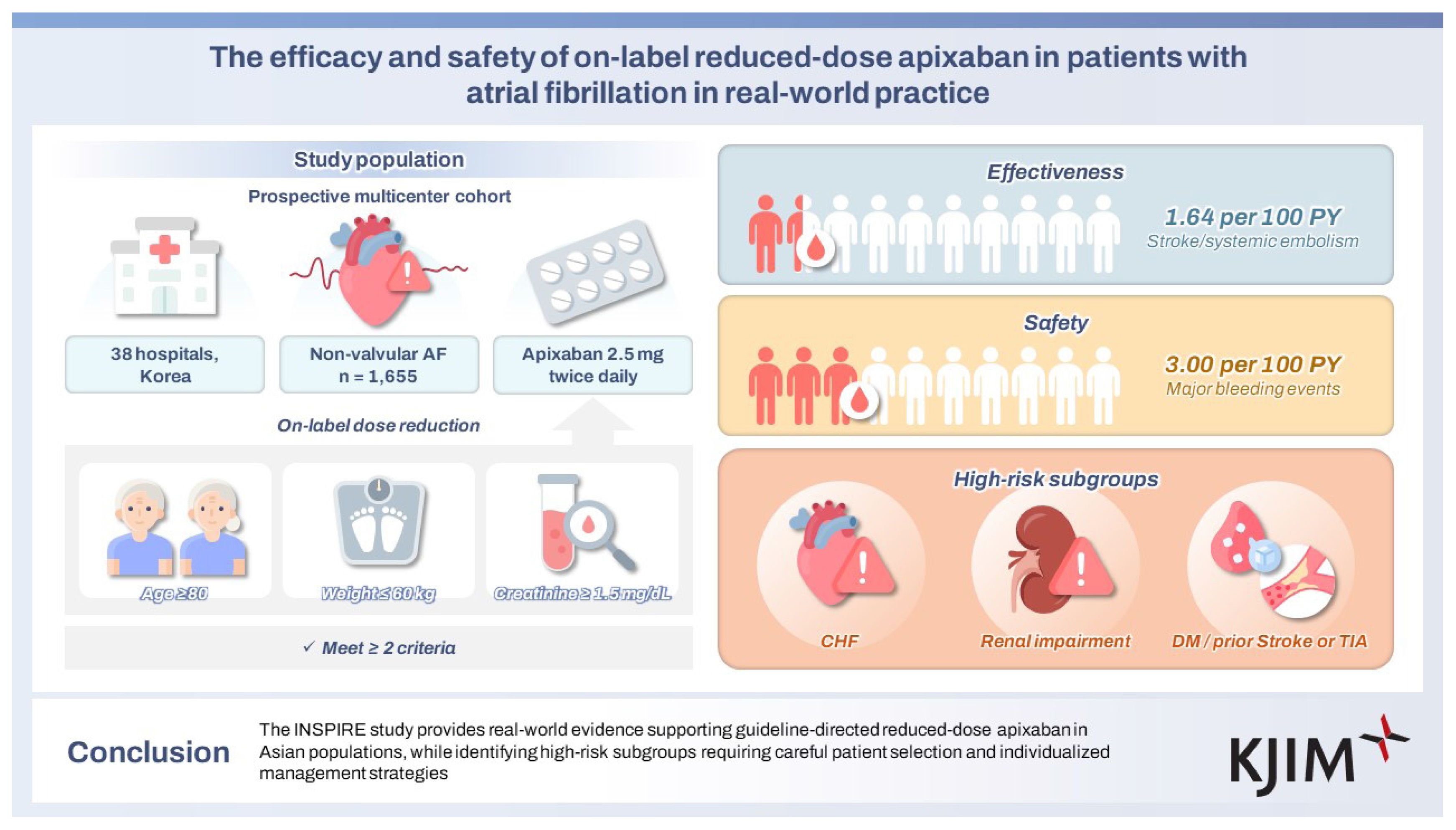
A total of 1,655 patients were enrolled (mean age 82.8 ± 4.4 yr; 60.5% female). During 1,467.6 patient-years of follow-up, stroke or systemic embolism occurred at 1.64 per 100 patient-years and major bleeding at 3.00 per 100 patient-years. In multivariate analysis, prior stroke/TIA (HR 2.59, p = 0.034), congestive heart failure (CHF) (HR 2.31, p = 0.041), and diabetes mellitus (DM) (HR 2.26, p = 0.047) were significant independent predictors of stroke/systemic embolism. For major bleeding, CHF (HR 2.48, p = 0.003) and severe renal impairment (eGFR 15–29 mL/min/1.73 m2; HR 3.33, p = 0.007) were significant predictors. The secondary composite outcome was independently associated with older age, CHF, DM, and graded renal impairment.
Conclusions
The INSPIRE study provides real-world evidence supporting guideline-directed reduced-dose apixaban in Asian populations, while identifying high-risk subgroups requiring careful patient selection and individualized management strategies.
INTRODUCTION
Atrial fibrillation (AF) is the most common sustained cardiac arrhythmia, affecting approximately 2–4% of the adult population worldwide, with its prevalence increasing substantially with advancing age [1]. AF is associated with a five-fold increase in the risk of ischemic stroke, and AF-related strokes tend to be more severe with higher mortality and disability rates compared with strokes of other etiologies [2,3]. Consequently, oral anticoagulation therapy has become a cornerstone of AF management to prevent thromboembolic complications.
Non-vitamin K antagonist oral anticoagulants (NOACs) have emerged as the preferred therapeutic option over warfarin for stroke prevention in patients with non-valvular AF [1]. Among NOACs, apixaban demonstrated superior efficacy in the landmark ARISTOTLE trial, showing significant reductions in stroke or systemic embolism (21%), major bleeding (31%), and all-cause mortality (11%) compared with warfarin [4]. Based on pharmacokinetic considerations, current guidelines recommend dose reduction of apixaban from the standard 5 mg twice daily to 2.5 mg twice daily for patients meeting at least two of the following criteria: age ≥80 years, body weight ≤ 60 kg, or serum creatinine ≥ 1.5 mg/dL [1,4].
However, several critical evidence gaps remain regarding reduced-dose apixaban therapy. First, in the pivotal ARISTOTLE trial, only 4.7% of patients in the apixaban arm received the reduced dose, substantially limiting the generalizability of trial findings to this vulnerable population [4]. Second, the 50% dose reduction from standard to reduced apixaban dosage is more substantial compared with the 25% reduction applied in rivaroxaban and dabigatran regimens, raising concerns about whether therapeutic efficacy is maintained [5]. Third, Asian patients, who tend to have lower body weight and potentially different pharmacokinetic profiles compared with Western populations, were underrepresented in the original pivotal trials [6,7]. Real-world data have suggested potential differences in bleeding patterns and optimal dosing strategies in East Asian populations, underscoring the need for population-specific evidence [8,9].
In Korea, the elderly population is rapidly growing, and the prevalence of AF is projected to increase substantially over the coming decades [10]. Korean patients with AF frequently meet multiple dose-reduction criteria due to their demographic characteristics, including older age and lower body weight. Yet, prospective data specifically evaluating on-label reduced-dose apixaban in this population remain scarce. Although retrospective registry studies have provided valuable insights, prospective multicenter data with systematic outcome ascertainment are essential to guide evidence-based clinical decision-making [11,12].
Therefore, we conducted the INSPIRE (effIcacy aNd Safety of low dose aPIxaban in patients with non-valvular AF In REal-world practice) study, a prospective, multicenter, observational cohort study designed to evaluate the efficacy and safety of on-label reduced-dose apixaban in Korean patients with AF who meet the guideline-recommended dose-reduction criteria.
METHODS
Study population
The INSPIRE study was a prospective, multicenter, observational cohort conducted across 38 tertiary and secondary hospitals in South Korea. Consecutive adult patients (aged ≥ 19 yr) with a diagnosis of non-valvular AF who were prescribed apixaban 2.5 mg twice daily for stroke prevention and met the on-label criteria for dose reduction were eligible for enrollment. On-label dose reduction was defined as meeting at least two of the following three criteria: age ≥ 80 years, body weight ≤ 60 kg, or serum creatinine ≥ 1.5 mg/dL. Patients with mechanical heart valves, moderate-to-severe mitral stenosis, pregnancy, or any formal contraindication to apixaban were excluded.
Data collection
Baseline data included demographic characteristics, medical history, cardiovascular risk factors, concomitant medications, and laboratory results. Thromboembolic risk was assessed using the CHA2DS2-VASc score, and bleeding risk was evaluated using the HAS-BLED score. Congestive heart failure (CHF) was defined as either a clinical diagnosis of heart failure (including prior hospitalization for heart failure or ongoing heart failure therapy) or objective evidence of left ventricular ejection fraction (≤ 40%) on echocardiography within 12 months. Renal function was assessed using the estimated glomerular filtration rate (eGFR) calculated by the Modification of Diet in Renal Disease (MDRD) equation and categorized as ≥ 60, 30–59, or 15–29 mL/min/1.73 m2.
Study outcomes
The primary efficacy outcome was ischemic/hemorrhagic stroke, including transient ischemic attack (TIA), or systemic thromboembolism. The primary safety outcome was major bleeding, defined according to the International Society on Thrombosis and Haemostasis (ISTH) criteria [13]. The secondary composite outcome included myocardial infarction, heart failure hospitalization, heart disease requiring cardiac intervention, and all-cause mortality.
Clinical and laboratory data were obtained at baseline and throughout a planned follow-up period of 12 months. Patients were censored at the time of an outcome event, discontinuation of apixaban, or completion of the study follow-up, whichever occurred first.
Statistical analysis
Continuous variables were presented as means with standard deviations, and categorical variables were presented as frequencies with percentages. Comparisons between groups were performed using chi-square tests or Fisher’s exact tests for categorical variables and independent t-tests or Mann–Whitney U tests for continuous variables, as appropriate.
Event-free survival was estimated using the Kaplan–Meier method and compared with the log-rank test. Time-toevent analyses were performed using Cox proportional hazards regression models. Univariate Cox regression was first performed for each candidate predictor. For the primary safety outcome (major bleeding; n = 44 events) and the secondary composite outcome (n = 97 events), multivariate models included clinically prespecified covariates: age, sex, CHF, hypertension, diabetes mellitus, prior stroke or TIA, vascular disease, non-paroxysmal AF, malignancy, and renal function (categorized as eGFR ≥ 60 [reference], 30–59, and 15–29 mL/min/1.73 m2). For the primary efficacy outcome (stroke/systemic embolism; n = 24 events), given the limited number of events, the multivariate model was restricted to three clinically relevant CHA2DS2-VASc components that demonstrated significance in univariate analysis (CHF, diabetes mellitus, and prior stroke/TIA). Additionally, eGFR was analyzed as a continuous variable to assess the linear relationship between renal function and outcomes (hazard ratio [HR] per 10 mL/min/1.73 m2 decrease). Results are reported as HRs with 95% confidence intervals (CIs). Two-sided p values < 0.05 were considered statistically significant.
Ethics statement
This study was approved by the local Institutional Review Board (IRB) of Keimyung University Dongsan Medical Center (IRB number: DSMC IRB 2019-07-028) and by the IRB of each participating center. All patients provided written informed consent prior to enrollment. The study was registered at the Clinical Research Information Service (Identifier: KCT0005916).
RESULTS
Baseline characteristics
From December 2019 through July 2023, a total of 1,675 patients with non-valvular AF were screened for the study. Among these, 20 patients did not meet the eligibility criteria, resulting in a final analysis of 1,655 patients who fulfilled the on-label criteria for reduced-dose apixaban. The mean age was 82.8 ± 4.4 years, and 1,002 patients (60.5%) were female. The mean body weight was 54.6 ± 8.1 kg, and the mean creatinine clearance was 38.8 ± 14.4 mL/min. The mean CHA2DS2-VASc score was 4.2 ± 1.3, and the mean HAS-BLED score was 1.7 ± 0.8. Common comorbidities included hypertension in 1,208 patients (73.0%), diabetes mellitus in 501 (30.3%), and CHF in 429 (25.9%). Non-paroxysmal AF was present in 814 patients (49.2%). Regarding concomitant medications, beta-blockers were used in 832 patients (50.3%), diuretics in 808 (48.8%), statins in 695 (42.0%), angiotensin receptor blockers in 653 (39.5%), calcium channel blockers in 494 (29.8%), and antiplatelet therapy in 93 (5.6%), of whom 87 received single antiplatelet therapy and 6 received dual antiplatelet therapy. Regarding renal function, 790 patients (47.7%) had eGFR ≥ 60 mL/min/1.73 m2, 647 (39.1%) had eGFR 30–59 mL/min/1.73 m2, and 218 (13.2%) had eGFR 15–29 mL/min/1.73 m2. The baseline characteristics of the study population are summarized in Table 1.

Baseline characteristics of the patients
Outcomes
The mean follow-up duration was 323.9 ± 112.3 days (median 364.0, interquartile range 324.0–391.0; total 1,467.6 patient-years). A total of 1,053 patients (63.6%) completed at least 350 days of follow-up. During the follow-up period, the primary efficacy outcome of stroke or systemic embolism occurred in 24 patients, with an incidence rate of 1.64 events per 100 patient-years (95% CI, 0.98–2.29). No systemic embolism events were observed. Ischemic stroke accounted for 8 events (0.55 per 100 patient-years), hemorrhagic stroke for 10 events (0.68 per 100 patient-years), and stroke of uncertain type for 6 events (0.41 per 100 patient-years). The primary safety outcome of major bleeding occurred in 44 patients, with an incidence rate of 3.00 events per 100 patient-years (95% CI, 2.11–3.88). Gastrointestinal bleeding was the most common type (17 events, 1.16 per 100 patient-years), followed by intracranial hemorrhage (10 events, 0.68 per 100 patient-years) (Table 2). The secondary composite outcome occurred in 97 patients, with an incidence rate of 6.61 events per 100 patient-years (95% CI, 5.29–7.92). Individual components included all-cause mortality in 44 patients (3.00 per 100 patient-years), heart failure hospitalization in 49 (3.34 per 100 patient-years), myocardial infarction in 1 (0.07 per 100 patient-years), and heart disease requiring cardiac intervention in 3 (0.20 per 100 patient-years) (Table 3). The Kaplan–Meier curves for stroke/systemic embolism, major bleeding, and the secondary composite outcome are illustrated in Figure 1.

Efficacy and safety outcomes

Secondary outcomes
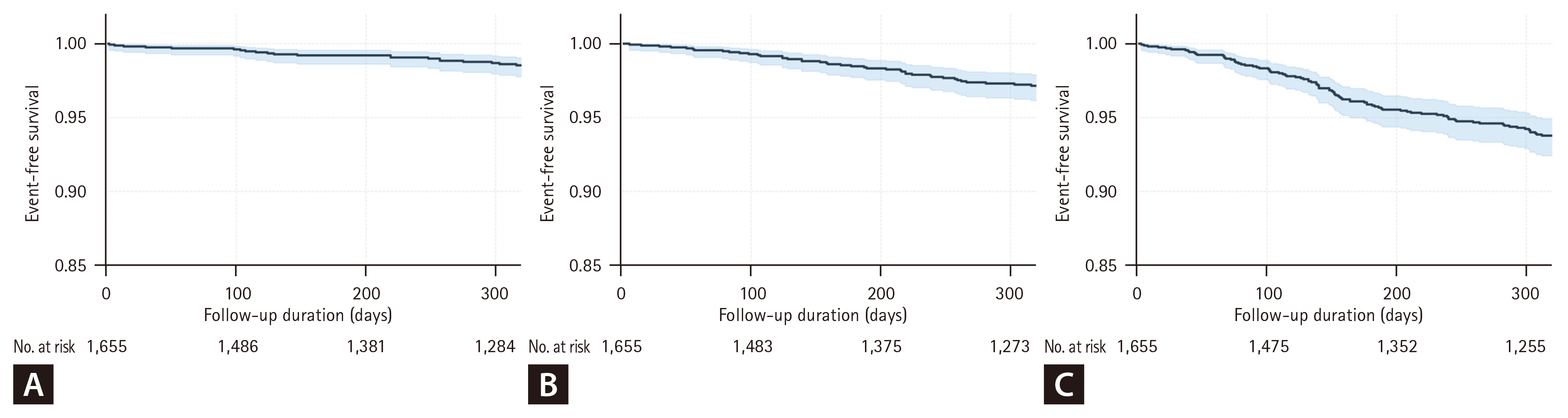
Kaplan–Meier estimates of event-free survival. (A) The cumulative incidence of stroke or systemic embolism. (B) Major bleeding. (C) The secondary composite outcome (myocardial infarction, heart failure hospitalization, cardiac intervention, or all-cause mortality). The number of patients at risk is shown below each panel. During a mean follow-up of 323.9 days (1,467.6 patient-years), stroke or systemic embolism occurred in 24 patients (1.64 per 100 patient-years), major bleeding in 44 patients (3.00 per 100 patient-years), and the secondary composite outcome in 97 patients (6.61 per 100 patient-years).
Univariate and multivariate Cox proportional hazards regression analyses were performed to evaluate the association between clinical factors and outcomes (Supplementary Table). For the primary efficacy outcome of stroke or systemic embolism (n = 24 events), univariate analysis identified CHF (HR 2.37, 95% CI 1.06–5.30, p = 0.035), diabetes mellitus (HR 2.38, 95% CI 1.07–5.29, p = 0.034), and prior stroke/TIA (HR 2.57, 95% CI 1.06–6.19, p = 0.036) as significant predictors. Given the limited number of events, the multivariate model was restricted to these three CHA2DS2-VASc components, and all three were confirmed as independent predictors: prior stroke/TIA (HR 2.59, 95% CI 1.07–6.26, p = 0.034), CHF (HR 2.31, 95% CI 1.03–5.17, p = 0.041), and diabetes mellitus (HR 2.26, 95% CI 1.01–5.03, p = 0.047).
For the primary safety outcome of major bleeding, CHF (HR 2.48, 95% CI 1.36–4.53, p = 0.003) and severe renal impairment (eGFR 15–29 mL/min/1.73 m2; HR 3.33, 95% CI 1.38–8.01, p = 0.007) were significant independent predictors. For the secondary composite outcome, older age (HR 1.10 per year, 95% CI 1.05–1.16, p < 0.001), CHF (HR 2.47, 95% CI 1.65–3.71, p < 0.001), diabetes mellitus (HR 1.74, 95% CI 1.13–2.67, p = 0.011), moderate renal impairment (eGFR 30–59 mL/min/1.73 m2; HR 1.68, 95% CI 1.04–2.72, p = 0.035), and severe renal impairment (eGFR 15–29 mL/min/1.73 m2; HR 3.55, 95% CI 1.98–6.40, p < 0.001) were all independently associated with adverse outcomes. The forest plots depicting HRs for each outcome are shown in Figure 2.
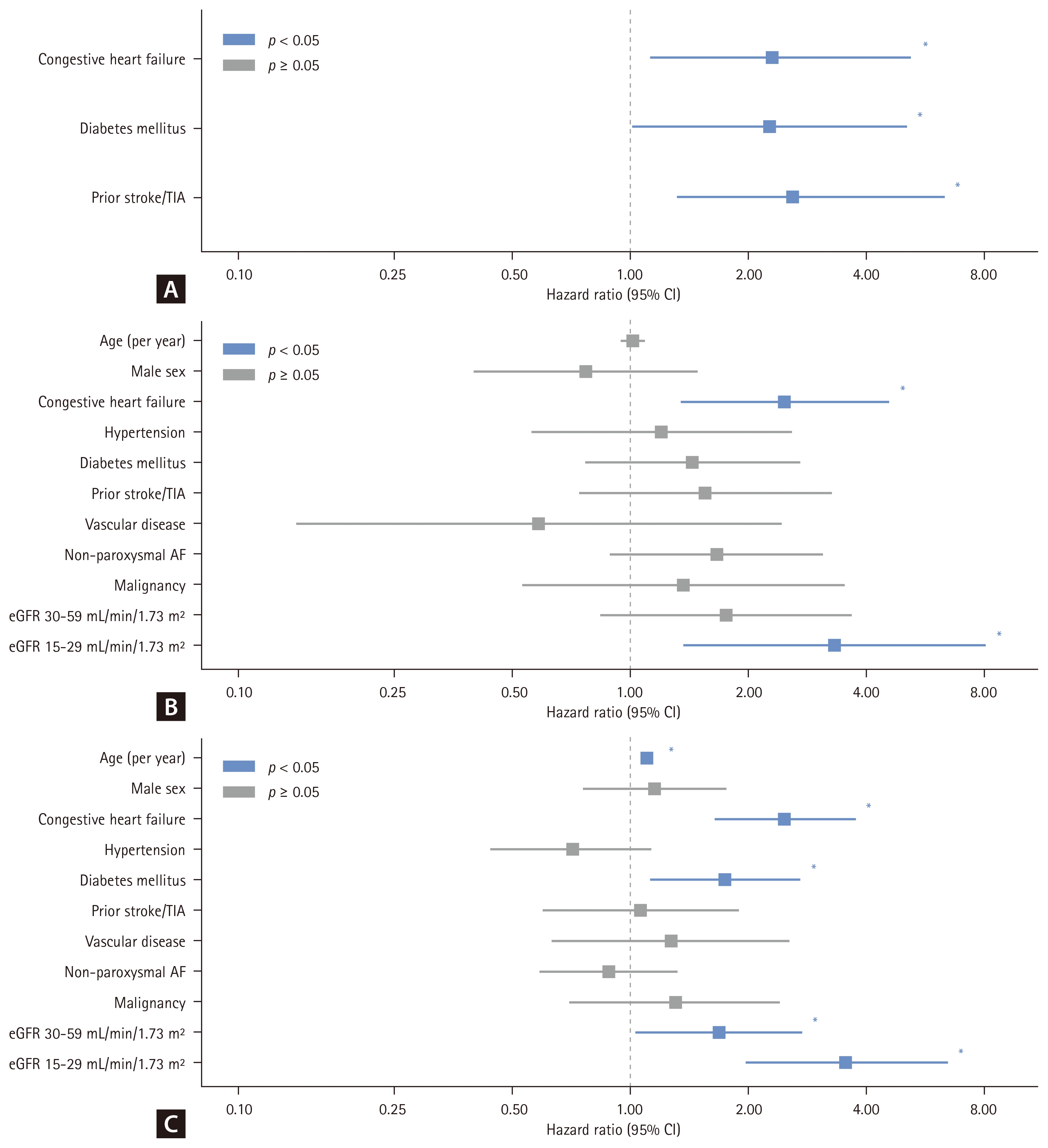
(A) Hazard ratios for stroke or systemic embolism, (B) major bleeding, and (C) the secondary composite outcome. (A) For the primary efficacy outcome of stroke or systemic embolism, given the limited number of events (n = 24), the multivariate model was restricted to three CHA2DS2-VASc components that demonstrated significance in univariate analysis (congestive heart failure, diabetes mellitus, and prior stroke/TIA), yielding an events-per-variable ratio of 8.0. (B) For major bleeding (n = 44 events) and (C) the secondary composite outcome (n = 97 events), the full multivariate model included 11 clinically prespecified covariates: age, sex, congestive heart failure, hypertension, diabetes mellitus, prior stroke/TIA, vascular disease, non-paroxysmal AF, malignancy, and renal function (eGFR 30–59 and 15–29 mL/min/1.73 m2, with ≥ 60 mL/min/1.73 m2 as reference). Hazard ratios are shown with 95% CIs on a logarithmic scale. Blue squares indicate statistically significant associations (p < 0.05); gray squares indicate non-significant associations. (A) All three CHA2DS2-VASc components were significant independent predictors of stroke or systemic embolism. (B) Congestive heart failure and severe renal impairment (eGFR 15–29 mL/min/1.73 m2) were significant predictors of major bleeding. (C) Older age, congestive heart failure, diabetes mellitus, and graded renal impairment were independent predictors of the secondary composite outcome. CI, confidence interval; TIA, transient ischemic attack; eGFR, estimated glomerular filtration rate; AF, atrial fibrillation.
DISCUSSION
Previous real-world studies have established the clinical outcomes of reduced-dose NOACs in Asian populations. In the ARISTOTLE East-Asian sub-analysis, the incidence of stroke/systemic embolism was 2.52 and major bleeding 3.46 per 100 patient-years [6]. The Japanese J-ELD AF Registry reported stroke/systemic embolism rate and major bleeding rates of 1.56 and 2.25 per 100 patient-years, respectively [14]. In Korea, the LEDIOS registry, a large-scale prospective Korean study of on-label reduced-dose edoxaban, demonstrated similarly low event rates for stroke/systemic embolism (1.13% per 100 patient-years) and major bleeding (1.34 per 100 patient-years) [12]. East-Asian post-marketing apixaban data have shown ischemic stroke/systemic embolism/TIA rates of approximately 1.0–1.7% per 100 patient-years and major bleeding rates of 2.4–3.3 per 100 patient-years [15–17]. These consistent findings across different NOACs and Asian populations suggest that appropriate dose reduction maintains therapeutic efficacy while potentially mitigating bleeding risk in vulnerable patient subgroups.
Our study results are consistent with this body of evidence: the INSPIRE cohort demonstrated stroke/systemic embolism at 1.64 per 100 patient-years and major bleeding at 3.00 per 100 patient-years, confirming that guideline-concordant reduced-dose apixaban yields comparable outcomes in Korean patients meeting dose reduction criteria. These findings underscore the importance of dosing fidelity in NOAC therapy. Recent data have demonstrated that inappropriate dose reduction—prescribing reduced-dose NOACs in patients who do not meet guideline-recommended criteria—is associated with increased risks of stroke and systemic embolism without a meaningful reduction in bleeding events [18,19]. Conversely, our results demonstrate that when dose reduction is performed according to established on-label criteria, the resulting clinical outcomes are favorable and consistent with expectations from pivotal trials and other real-world registries. These observations reinforce the need for clinicians to strictly adhere to guideline-directed dosing criteria rather than empirically reducing doses based on perceived patient frailty or bleeding concerns.
In our analysis of stroke or systemic embolism, CHF (HR 2.31), diabetes mellitus (HR 2.26), and prior stroke/TIA (HR 2.59) were all confirmed as independent predictors in the multivariate model restricted to CHA2DS2-VASc components. These findings reinforce the clinical relevance of the CHA2DS2-VASc scoring system for risk stratification even among patients receiving reduced-dose apixaban and are consistent with prior studies demonstrating the predictive value of these established risk factors in anticoagulated AF populations [18].
CHF consistently emerged as a strong independent predictor across all three outcomes: stroke/systemic embolism (HR 2.31), major bleeding (HR 2.48), and the secondary composite outcome (HR 2.47). This universality suggests that CHF reflects a fundamentally higher-risk phenotype that transcends individual outcome categories. Severe renal impairment (eGFR 15–29 mL/min/1.73 m2) was also strongly associated with both major bleeding (HR 3.33) and composite outcomes (HR 3.55), underscoring the particularly vulnerable status of this subgroup despite on-label dose reduction. In the secondary composite outcome, a graded relationship between renal dysfunction and adverse events was observed, with both moderate (eGFR 30–59; HR 1.68, p = 0.035) and severe (eGFR 15–29; HR 3.55, p < 0.001) renal impairment significantly associated with worse outcomes. The composite outcome provides a more holistic assessment of overall patient risk, illustrating that multimorbidity—particularly CHF and impaired renal function—drives adverse outcomes across both ischemic and bleeding domains. These observations align with prior studies identifying heart failure as a key driver of adverse events in anticoagulated AF patients, likely reflecting the complex interplay between neurohormonal activation, hepatic congestion affecting drug metabolism, and inherent vascular fragility in this population [19–21].
Several limitations of our study should be acknowledged. First, our study was an observational cohort study, and longer-term outcomes beyond one year remain to be determined. Second, all patients were enrolled in Korea, and the generalizability of our findings to non-Asian populations may be limited. Third, therapeutic drug levels were not systematically measured; thus, pharmacokinetic variability could not be fully accounted for. Fourth, the limited number of stroke/systemic embolism events (n = 24) restricted the number of covariates that could be included in the multivariate model for this outcome. Finally, we did not specifically assess patient compliance with reduced-dose apixaban during follow-up. Although previous studies have consistently reported excellent adherence to NOAC therapy in real-world practice, the absence of direct compliance evaluation in our study should be acknowledged.
In conclusion, in this large, prospective, multicenter Korean cohort, on-label reduced-dose apixaban demonstrated effective stroke prevention with acceptable bleeding risk in patients with AF who meet dose reduction criteria. However, patients with concomitant CHF and impaired renal function remained at heightened risk of both ischemic and bleeding complications, highlighting the need for careful patient selection and individualized management strategies in these high-risk subgroups.
KEY MESSAGE
1. In a large prospective multicenter Korean cohort of 1,655 elderly AF patients meeting on-label criteria for reduced-dose apixaban, the rates of stroke or systemic embolism (1.64 per 100 patient-years) and major bleeding (3.00 per 100 patient-years) were comparable to those reported in other East Asian real-world registries, supporting the efficacy and safety of guideline-directed dose reduction in this vulnerable population.
2. CHF and graded renal impairment identify particularly vulnerable subgroups with elevated risks of both bleeding and composite adverse outcomes, underscoring the need for careful patient selection and individualized management despite on-label dose reduction.
Data availability statement
The datasets generated during and/or analysed during the current study are available from the corresponding author on reasonable request.
Notes
CRedit authorship contributions
Min-Su Jung: data curation, formal analysis, visualization; Jongmin Hwang: data curation, formal analysis, validation, writing - original draft, writing - review & editing, visualization; Seongwook Han: conceptualization, methodology, resources, investigation, data curation, formal analysis, validation, writing - original draft, writing - review & editing, supervision, project administration, funding acquisition; Hyoung- Seob Park: investigation, data curation; Tae-Wan Chung: investigation, data curation; Eue-Keun Choi: investigation, data curation; Il- Young Oh: methodology, investigation, supervision; Hyung Wook Park: investigation, data curation; Sung Ho Lee: investigation, data curation; Jong-Sung Park: investigation; Yae Min Park: investigation; Gyo-Seung Hwang: investigation; Dong-Hyeok Kim: investigation; Jin-Kyu Park: investigation; Jong-Il Choi: investigation, data curation
Conflicts of interest
The authors disclose no conflicts.
Funding
This research was funded by the Chong Kun Dang Pharmaceutical Co.
Affiliations of the INSPIRE study investigators
Minsu Jung, Jongmin Hwang, Seongwook Han, Hyoung-Seob Park, Tae Wan Chung (Division of Cardiology, Department of Internal Medicine, Keimyung University Dongsan Hospital, Daegu, Korea); Eue-Keun Choi (Division of Cardiology, Department of Internal Medicine, Seoul National University Hospital, Seoul, Korea); Il-Young Oh (Cardiovascular Center, Seoul National University Bundang Hospital, Seoul National University College of Medicine, Seongnam, Korea); Hyung Wook Park, Ki Hong Lee (Department of Cardiovascular Medicine, Chonnam National University Hospital, Gwangju, Korea); Sung Ho Lee, Jong-Young Lee (Division of Cardiology, Department of Internal Medicine, Kangbuk Samsung Hospital, Sungkyunkwan University School of Medicine, Seoul, Korea); Jong-Sung Park (Department of Cardiology, Dong-A University College of Medicine, Busan, Korea); Yae Min Park (Department of Internal Medicine, Gachon University Gil Medical Center, Gachon University College of Medicine, Incheon, Korea); Gyo-Seung Hwang (Department of Cardiology, Ajou University School of Medicine, Suwon, Korea); Dong-Hyeok Kim (Division of Cardiology, Ewha Womans University Seoul Hospital, Seoul, South Korea); Jin-Kyu Park, Jeong-Hun Shin (Department of Cardiology, Hanyang University Seoul Hospital, Seoul, Korea); Jong-Il Choi, Jaemin Shim (Division of Cardiology, Department of Internal Medicine, Anam Hospital, Korea University College of Medicine, Seoul, Korea); Jum-Suk Ko (Division of Cardiology, Department of Internal Medicine, Wonkwang University School of Medicine, Iksan, Korea); Hwan-Cheol Park (Division of Cardiology, Department of Internal Medicine, Hanyang University Guri Hospital, Hanyang University College of Medicine, Guri, Korea); Woo-Hyun Lim (Division of Cardiology, Department of Internal Medicine, Boramae Medical Center, Seoul National University College of Medicine, Seoul, Korea); Seung-Yong Roh (Division of Cardiology, Department of Internal Medicine, Korea University Guro Hospital, Seoul, Korea); Ji-Eun Song (Division of Cardiology, Department of Internal Medicine, Presbyterian Medical Center, Jeonju, Korea); Dong Woon Jeon (Division of Cardiology, Department of Internal Medicine, National Health Insurance Service Ilsan Hospital, Goyang, Korea); Young Keun On (Division of Cardiology, Department of Medicine, Samsung Medical Center, Sungkyunkwan University School of Medicine, Seoul, Korea); Jeong-Hun Shin (Division of Cardiology, Department of Internal Medicine, Hanyang University College of Medicine, Seoul, Korea); Dae Kyeong Kim (Department of Cardiology, Busan Paik Hospital, Inje University College of Medicine, Busan, Korea); Tae-Hoon Kim (Division of Cardiology, Department of Internal Medicine, Yonsei University College of Medicine, Seoul, Korea); Min-Soo Ahn (Division of Cardiology, Department of Internal Medicine, Yonsei University Wonju College of Medicine, Wonju, Korea); June Namgung (Division of Cardiology, Department of Internal Medicine, Inje University Ilsan Paik Hospital, Goyang, Korea); Jung Ho Heo (Division of Cardiology, Department of Internal Medicine, Kosin University Gospel Hospital, Kosin University College of Medicine, Busan, Korea); Jin-Bae Kim (Division of Cardiology, Department of Internal Medicine, Kyung Hee University Hospital, Seoul, Korea); Dae-Hyeok Kim (Division of Cardiology, Department of Internal Medicine, Inha University Hospital, Inha University College of Medicine, Incheon, Korea); Hye Bin Gwag (Division of Cardiology, Department of Internal Medicine, Samsung Changwon Hospital, Sungkyunkwan University School of Medicine, Changwon, Korea); Kee-Joon Choi (Department of Cardiology, Heart Institute, Asan Medical Center, University of Ulsan College of Medicine, Korea); Eun-Sun Jin (Division of Cardiology, Department of Internal Medicine, Kyung Hee University Hospital at Gangdong, Seoul, Korea); Sang-Hoon Seol (Division of Cardiology, Department of Internal Medicine, Haeundae Paik Hospital, Inje University College of Medicine, Busan, Korea); Dong-Gu Shin (Division of Cardiology, Department of Internal Medicine, Yeungnam University Medical Center, Daegu, Korea); Young Soo Lee (Department of Internal Medicine, Sahmyook Medical Center, Seoul, Korea); Joon-Hyouk Choi (Department of Internal Medicine, Jeju National University Hospital, Jeju National University School of Medicine, Jeju, Korea); Unjeong Do (Division of Cardiology, Dongguk University Ilsan Hospital, Dongguk University College of Medicine, Goyang, Korea); Dong-Kyu Jin (Department of Internal Medicine, Cheonan Hospital, Soonchunhyang University College of Medicine, Cheonan, Korea).