Korean College of Rheumatology treatment recommendations for patients with axial spondyloarthritis: 2026 update
Article information

Abstract
We aimed to develop updated evidence-based recommendations for the management of adult patients with axial spondyloarthritis (axSpA) in Korea. The Korean College of Rheumatology convened a multidisciplinary panel to update the 2023 axSpA guideline. Twenty key clinical questions were formulated using the PICO framework. Systematic literature searches were conducted in PubMed, Embase, and the Cochrane Library for studies published between February 2021 and December 2024. Evidence was appraised using the GRADE methodology, and recommendations were finalized through a modified Delphi consensus process. Twenty recommendations were developed covering disease activity monitoring, non-pharmacological interventions, pharmacological treatment, treatment sequencing, tapering strategies, comorbidity management, surgical interventions, and safety monitoring. Key recommendations include implementation of a treat-to-target strategy, use of Axial Spondyloarthritis Disease Activity Score for disease assessment, smoking cessation and exercise, nonsteroidal anti-inflammatory drugs (NSAIDs) as first-line therapy, and the use of tumor necrosis factor inhibitors, interleukin-17 inhibitors, or Janus kinase inhibitors in patients with active disease refractory to NSAIDs. Recommendations were also provided for treatment selection according to extra-musculoskeletal manifestations and for monitoring treatment-related adverse events. These updated recommendations provide evidence-based guidance for the comprehensive management of axSpA in Korea and aim to improve clinical outcomes, quality of life, and standardization of care.
INTRODUCTION
Axial spondyloarthritis (axSpA) is a chronic inflammatory rheumatic disease characterized by inflammation of the sacroiliac joints and spine, resulting in inflammatory back pain, stiffness, and progressive structural damage. In addition to axial manifestations, patients may experience peripheral musculoskeletal involvement, including peripheral arthritis, enthesitis, and dactylitis. Extra-musculoskeletal manifestations such as uveitis, psoriasis, and inflammatory bowel disease (IBD) are also common and contribute substantially to disease burden [1].
The disease often affects individuals during early adulthood and may lead to irreversible structural damage, impaired spinal mobility, functional disability, reduced work productivity, and deterioration in health-related quality of life. Consequently, timely diagnosis and appropriate management are essential to achieve optimal clinical outcomes and prevent long-term complications.
Over the past decade, the management of axSpA has evolved considerably. While nonsteroidal anti-inflammatory drugs (NSAIDs) remain the cornerstone of initial treatment, the introduction of biologic disease-modifying antirheumatic drugs (bDMARDs), including tumor necrosis factor inhibitor (TNFi) and interleukin-17 inhibitor (IL-17i), has substantially improved disease control and patient outcomes. More recently, Janus kinase inhibitor (JAKi) have emerged as an effective therapeutic option, further expanding the treatment landscape. In parallel with advances in pharmacological therapies, increasing evidence supports the importance of non-pharmacological interventions, including exercise, patient education, cardiovascular risk management, and appropriate surgical treatment in selected patients.
Evidence-based clinical practice guidelines play a critical role in standardizing care, improving clinical outcomes, facilitating shared decision-making, and informing healthcare policy. Several international organizations, including the Assessment of SpondyloArthritis International Society (ASAS), the European Alliance of Associations for Rheumatology (EULAR), and the American College of Rheumatology (ACR), have published recommendations for the management of axSpA. However, differences in healthcare systems, reimbursement policies, treatment accessibility, and clinical practice patterns limit the direct applicability of international recommendations to individual countries.
The Korean College of Rheumatology (KCR) previously published evidence-based recommendations for the management of axSpA in 2023 [2]. Since then, substantial new evidence has emerged regarding treat-to-target (T2T) strategies, disease activity assessment tools, biologic and targeted synthetic therapies, treatment tapering approaches, and long-term safety monitoring. Furthermore, several newly approved therapeutic agents have become available, necessitating an updated evaluation of the current evidence.
Therefore, the present guideline was developed to provide updated, evidence-based recommendations for the management of adult patients with axSpA in Korea. The objectives of this guideline are to optimize disease control, improve physical function and quality of life, prevent structural progression and disease-related complications, promote appropriate use of healthcare resources, and support evidence-based clinical decision-making in routine practice. The recommendations were developed using a systematic review of the literature and the Grading of Recommendations Assessment, Development and Evaluation (GRADE) methodology, with consideration of patient values and preferences, resource utilization, and the characteristics of the Korean healthcare system. This guideline update includes 20 evidence-based recommendations addressing pharmacological and non-pharmacological management, disease monitoring, treatment sequencing, tapering strategies, comorbidity management, and drug safety in patients with axSpA.
RECOMMENDATION DEVELOPMENT
Guideline development process
The present clinical practice guideline was developed in accordance with the principles outlined in the Appraisal of Guidelines for Research and Evaluation II (AGREE II) instrument, an internationally recognized framework for guideline development and evaluation. The guideline update was supported by the KCR and was conducted through a structured, transparent, and evidence-based process.
Guideline development committee and external review committee
A Guideline Development Committee consisting of six members of the Korean College of Rheumatology-Alliance of eXperts In Spondyloarthritis (KCR-AXIS) was established to conduct the evidence review, formulate recommendations, and oversee guideline development. Following completion of the evidence review, Delphi consensus process, and drafting of the recommendations, the final guideline document was reviewed and formally endorsed by KCR-AXIS.
To enhance the methodological rigor, clinical relevance, feasibility, and stakeholder acceptability of the guideline, the draft recommendations underwent external review by a multidisciplinary External Review Committee comprising two primary care rheumatologists, specialists in rehabilitation medicine and pain medicine, a representative of the Korean College of Rheumatology Health Insurance Committee, and a patient representative from the Korean Ankylosing Spondylitis Association. In addition, an expert in evidence-based medicine and GRADE methodology provided methodological consultation during the guideline development process. The composition of the Guideline Development Committee, External Review Committee, and methodological advisor is provided in Supplementary Table 1.
The sponsoring organization did not participate in the selection of committee members, evidence appraisal, recommendation formulation, or voting procedures. All participants involved in guideline development completed a standardized declaration form for potential financial and non-financial conflicts of interest prior to participation. The declarations included previous involvement in guideline development, employment relationships, research funding, consulting activities, honoraria, and other potentially relevant interests. The submitted declarations were reviewed by the Guideline Development Committee, and conflicts relevant to individual key questions were managed in accordance with the committee’s conflict-of-interest policy, including restriction from recommendation formulation or voting when applicable. Relevant financial relationships are disclosed in the Conflicts of interest section of this article. External reviewers independently evaluated the evidence profiles, certainty assessments, recommendation strength, and final recommendation statements. This guideline represents an update of the 2023 KCR clinical practice guideline for axSpA. Existing recommendations were systematically reviewed and revised when new evidence warranted modification, while new recommendations were developed for emerging clinical questions not addressed in the previous guideline.
Identification of key questions and outcome selection
The key clinical questions were developed by the Guideline Development Committee through a series of structured meetings. Existing recommendations from the 2023 Korean clinical practice guideline for axSpA served as the foundation for the update [2]. Emerging evidence, unmet clinical needs, and changes in therapeutic strategies were reviewed to determine priorities for revision.
Clinical questions were structured according to the Population–Intervention–Comparator–Outcome (PICO) framework. Health outcomes relevant to each question were identified and subsequently classified according to the GRADE methodology. Outcomes were categorized as either critical or important based on their anticipated impact on patient prognosis, quality of life, functional status, and treatment decision-making. Selected key questions are summarized in Table 1.

Key questions
Literature search and study selection
Systematic literature searches were conducted for each of the 20 predefined key questions. Search strategies were adapted from those used in the 2023 guideline and updated to capture newly published evidence. Electronic databases including PubMed, Embase, and the Cochrane Library were systematically searched. Additional manual searches of reference lists and relevant review articles were performed to identify potentially eligible studies. Search strategies were developed with the assistance of an experienced medical librarian and were reviewed by members of the Guideline Development Committee. The search period covered studies published between February 1, 2021 and December 31, 2024. The detailed literature search strategies for each key question are presented in Supplementary Table 2. Evidence included both newly identified studies and studies incorporated in the previous guideline update. Eligible studies included randomized controlled trials, comparative observational studies, and systematic reviews involving adult patients with axSpA. Case reports, expert opinions, studies exclusively involving pediatric populations, and studies focusing solely on non-axial diseases were excluded. Study selection was conducted independently by two reviewers. Following removal of duplicate records, titles and abstracts were screened according to predefined eligibility criteria based on the corresponding PICO framework. Full-text articles were subsequently assessed for eligibility. Discrepancies between reviewers were resolved through discussion and consensus. Reasons for exclusion at the full-text review stage were documented in PRISMA flow diagrams for each key question (Supplementary Fig. 1).
Risk-of-bias assessment
The methodological quality and risk of bias of included studies were assessed using validated tools according to study design; Systematic reviews: AMSTAR 2, Randomized controlled trials: Cochrane Risk of Bias 2.0 (RoB 2), Non-randomized intervention studies: ROBINS-I, Observational studies: RoBANS.
All assessments were performed independently by two reviewers. Disagreements were resolved through discussion and consensus among guideline panel members. Risk-of-bias assessment procedures followed the recommendations outlined in the Korean Clinical Practice Guideline Development Handbook (Version 2). The risk-of-bias assessment for each key question is summarized in Supplementary Figure 2.
Evidence synthesis
Evidence synthesis incorporated both benefits and harms associated with each intervention. When appropriate, quantitative meta-analyses were performed to generate pooled effect estimates. Relative treatment effects were converted into absolute risk differences per 1,000 patients and incorporated into GRADE evidence profiles. To facilitate clinically meaningful interpretation, pooled estimates were evaluated against predefined minimal clinically important differences (MCIDs). Only effects exceeding the corresponding MCID thresholds were considered clinically important and were incorporated into recommendation development. The certainty of evidence was evaluated by considering risk of bias, inconsistency, indirectness, imprecision, and publication bias. The balance between desirable and undesirable effects was assessed through structured discussions among guideline panel members. Patient values and preferences were incorporated through participation of patient representatives during the external review process. Feedback regarding treatment goals, medication burden, risk tolerance, monitoring requirements, and healthcare utilization was considered during formulation of recommendations. The GRADE evidence profiles for each key question are provided in Supplementary Table 3.
Certainty of evidence and strength of recommendations
The certainty of evidence and strength of recommendations were assessed using the GRADE methodology. Two reviewers independently evaluated the certainty of evidence for each key question, and disagreements were resolved through consensus. The certainty of evidence was categorized as: High, Moderate, Low, and Very low. The certainty rating was determined by evaluating risk of bias, inconsistency, indirectness, imprecision, and publication bias. Recommendation strength and direction were determined by considering four domains: Certainty of evidence, Balance between benefits and harms, Patient values and preferences, Resource utilization and cost considerations. Economic considerations were evaluated within the context of the Korean National Health Insurance system and the national rare and intractable disease reimbursement program. Both direct treatment costs and indirect societal costs associated with disease progression, disability, and loss of productivity were considered. Recommendations were classified as either strong or conditional, for or against an intervention, depending on the overall balance of these factors. When the available evidence was insufficient to support a recommendation in either direction, no recommendation was issued. Definitions of the certainty of evidence and strength of recommendations are provided in Table 2.

GRADE certainty of evidence and strength of recommendation
Consensus process
Draft recommendations were developed following evidence review and were subsequently refined through a modified Delphi process. The voting panel consisted of 15 experts with extensive clinical and research experience in axSpA. Consensus voting was conducted electronically. Panel members reviewed evidence summaries and recommendation statements before casting their votes. Additional comments and suggestions were collected through email correspondence to facilitate discussion and maximize participation.
Agreement was assessed using a 5-point Likert scale: 1) Strongly disagree, 2) Disagree, 3) Neutral, 4) Agree, 5) Strongly agree. Consensus was defined a priori as ≥ 80% of voting panel members selecting either “agree” or “strongly agree”. Recommendations failing to achieve the predefined consensus threshold during the initial round underwent further discussion and revision. Modified statements were subsequently subjected to a second round of voting. Final recommendations were established only after achieving the predefined level of consensus. The results of the Delphi consensus process are provided in Supplementary Material 1.
RECOMMENDATION FOR THE TREATMENT OF PATIENTS WITH axSpA
Twenty key clinical questions were identified and addressed through systematic literature review and evidence appraisal. Evidence was evaluated according to the GRADE framework, considering the certainty of evidence, balance of benefits and harms, patient values and preferences, feasibility, and resource utilization. Final recommendations were developed through a structured consensus process involving the guideline development panel. The updated guideline comprises 20 recommendations encompassing T2T strategies, disease activity monitoring, non-pharmacological management, pharmacological treatment, treatment optimization, management of extra-articular manifestations and comorbidities, and surgical interventions. The strength of recommendation and certainty of evidence for each recommendation are summarized in Table 3. Compared with the 2023 Korean guideline, several recommendations were revised or newly introduced based on recently available evidence. A summary of the major updates is presented in Table 4.

KCR treatment recommendation for patients with axSpA

Major updates from the 2023 Korean clinical practice guideline
Available targeted therapies for axSpA in Korea
At the time of guideline development, approved targeted therapies for axSpA in Korea included TNFis, IL-17is, and JAKis. These agents formed the basis for the pharmacologic recommendations presented in this guideline (Table 5).

Targeted therapies currently available for axSpA in Korea
Disease monitoring and assessment
Recommendation 1. We suggest a T2T strategy to achieve effective control of disease activity in adult patients with axSpA.
One cluster-randomized controlled trial (TICOSPA) evaluated a T2T strategy targeting Axial Spondyloarthritis Disease Activity Score (ASDAS) <2.1 in patients with active axSpA. Compared with usual care, the T2T strategy increased the likelihood of achieving low disease activity (76.4% vs. 59.7%; odds ratio [OR] 2.18, 95% confidence interval [CI] 1.06–4.48), while no significant difference was observed in ASAS-HI improvement [3]. The certainty of evidence was rated as very low because evidence was derived from a single open-label trial with concerns regarding risk of bias and imprecision. Nevertheless, the panel considered that tighter disease control may provide meaningful clinical benefits without increasing harm. Although implementation may be challenging in some clinical settings because of the need for frequent monitoring and additional healthcare resources, the panel judged that the potential benefits outweighed these limitations and therefore issued a conditional recommendation in favor of a T2T strategy (agreement level: 93.3%).
Recommendation 2. We suggest the use of the ASDAS rather than the BASDAI for disease activity assessment and prediction of structural progression.
Several studies have demonstrated that ASDAS provides superior assessment of disease activity compared with BASDAI. In a validation study including 708 patients with radiographic axSpA (r-axSpA), all four ASDAS versions showed significantly greater discriminatory capacity across disease activity states than Bath Ankylosing Spondylitis Disease Activity Index (BASDAI) [4]. Similarly, in a Chinese cohort of 104 patients with r-axSpA or undifferentiated spondyloarthritis, ASDAS showed stronger correlations with inflammatory markers and was more sensitive in detecting changes following TNFi therapy [5]. In the ASCEND trial involving 266 patients with active r-axSpA, ASDAS demonstrated greater responsiveness to treatment than BASDAI, as reflected by higher standardized response means [6].
Evidence also supports the prognostic value of ASDAS for structural progression. In the OASIS cohort, which followed 184 patients with axSpA for 12 years, each 1-unit increase in ASDAS was associated with a 0.72-unit increase in modified Stoke Ankylosing Spondylitis Spinal Score (mSASSS) progression over 2 years (95% CI 0.41–1.03). Patients with very high disease activity (ASDAS >3.5) experienced 2.31 additional mSASSS units of progression over 2 years compared with patients with inactive disease (ASDAS <1.3), exceeding the threshold generally considered clinically meaningful radiographic progression [7]. The certainty of evidence was rated as low because evidence for radiographic progression was primarily derived from observational studies and concerns regarding risk of bias and indirectness remained. Nevertheless, the panel considered that ASDAS provides a more objective assessment of disease activity by incorporating acute-phase reactants and offers additional prognostic information regarding structural progression. Given the minimal additional burden associated with laboratory testing and the absence of evidence suggesting increased harm, the panel issued a conditional recommendation in favor of ASDAS-based monitoring (agreement level: 100%).
Patient education and non-pharmacologic management
Recommendation 3. We suggest patient education, including disease-related information and self-management training, to improve quality of life and pain management.
Several randomized controlled trials have evaluated the effects of patient education programs in patients with ax-SpA. Educational interventions, including disease-specific education, self-management training, nurse-led monitoring programs, home-based exercise education, peer-support programs, and smartphone-based educational platforms, were associated with improvements in disease activity, physical function, pain, and quality of life compared with usual care or educational materials alone [8,9]. In particular, home-based exercise education and digital education programs demonstrated improvements in BASDAI and Bath Ankylosing Spondylitis Functional Index (BASFI) scores, while peer-led educational programs were associated with better quality-of-life outcomes [9]. No direct harms related to patient education interventions were reported. Although the observed improvements in physical function and quality of life were generally modest and did not consistently exceed established thresholds for clinical significance, educational programs were associated with enhanced disease knowledge, self-management skills, treatment adherence, and patient engagement. The certainty of evidence was rated as low because most studies were open-label and relied on patient-reported outcomes, resulting in concerns regarding risk of bias. Nevertheless, the panel considered that patient education is a low-risk intervention that may improve self-management and support long-term disease control. Given its favorable safety profile, high patient acceptability, and relatively low resource requirements, the panel issued a conditional recommendation in favor of structured patient education programs (agreement level: 100%).
Recommendation 4-1. We recommend smoking cessation to reduce the risk of structural spinal progression and ankylosis.
Current smoking has been identified as an independent risk factor for radiographic progression in patients with axSpA. In the GESPIC cohort, smokers had a significantly greater risk of spinal structural progression than non-smokers, with an approximately 2.5-fold higher likelihood of experiencing clinically meaningful worsening of mSASSS over 2 years [10]. The association between smoking and radiographic progression remained significant after adjustment for other known risk factors, including baseline structural damage and elevated C-reactive protein (CRP) levels [10]. The certainty of evidence was rated as very low because the available evidence was derived from a single observational cohort study and was subject to potential residual confounding and risk of bias. Nevertheless, the panel considered that smoking cessation has well-established health benefits, carries virtually no direct harm, and may reduce the risk of irreversible spinal structural damage. Given the magnitude of potential benefit, the absence of meaningful harm, and the strong patient preference for preventing long-term disability and spinal ankylosis, the panel issued a strong recommendation in favor of smoking cessation (agreement level: 93.3%).
Recommendation 4-2. We recommend regular exercise to improve disease activity and physical function.
Several randomized and controlled studies have demonstrated that exercise therapy improves disease activity, physical function, and spinal mobility in patients with axSpA. Various exercise modalities, including aerobic exercise, home-based exercise programs, pilates, supervised rehabilitation, and mobility exercises, were associated with improvements in BASDAI, BASFI, and Bath Ankylosing Spondylitis Metrology Index (BASMI) scores compared with usual care or no exercise intervention [8,11,12]. In addition, exercise was shown to improve cardiorespiratory fitness, fatigue, pain, and overall physical performance [11,12]. The certainty of evidence was rated as low for disease activity and physical function outcomes because most studies were unblinded and relied on patient-reported outcome measures. However, evidence supporting improvements in spinal mobility was more robust, and the beneficial effects of exercise were consistently observed across different exercise modalities and study populations. No serious adverse events attributable to exercise were reported. Given its demonstrated benefits on disease activity, physical function, and mobility, together with its favorable safety profile, high patient acceptability, and low cost, the panel issued a strong recommendation in favor of regular exercise for patients with axSpA (agreement level: 93.3%).
Recommendation 5. We do not recommend acupuncture for improving pain, disease activity, or physical function in patients with axSpA.
Only one small randomized sham-controlled trial evaluated acupuncture in patients with axSpA. In this study, acupuncture did not demonstrate statistically significant improvements in pain, disease activity, or physical function compared with sham acupuncture after 4 weeks of treatment [13]. No serious adverse events related to acupuncture were reported. The certainty of evidence was rated as very low because the available evidence was derived from a single study with an extremely small sample size and substantial imprecision. In addition, the observed treatment effects did not reach clinically meaningful thresholds for improvement. Although acupuncture appears to have a favorable safety profile, the panel considered that the current evidence is insufficient to support its routine use for improving pain, disease activity, or physical function in patients with axSpA. Given the lack of demonstrated benefit, the very low certainty of evidence, and the availability of alternative interventions with established efficacy, the panel issued a conditional recommendation against the routine use of acupuncture (agreement level: 93.3%).
Conventional pharmacologic treatment
Recommendation 6. We recommend NSAIDs as first-line pharmacologic therapy for active axSpA.
Multiple randomized controlled trials have consistently demonstrated that NSAIDs improve pain, disease activity, and physical function in patients with active axSpA. Compared with placebo, NSAID treatment resulted in clinically meaningful improvements in pain, BASDAI, and BASFI scores, with effect sizes exceeding established thresholds for MCIDs [14–16]. These benefits were observed across different NSAID agents and were maintained in both short-term and longer-term studies. The certainty of evidence was rated as high because the evidence was derived from well-conducted randomized controlled trials with consistent results and precise effect estimates. Although adverse events occurred slightly more frequently with NSAIDs than with placebo, no significant increase in serious harm was observed. Given the substantial and clinically meaningful benefits, the high certainty of evidence, favorable patient acceptance, and cost-effectiveness of treatment, the panel issued a strong recommendation in favor of NSAIDs as first-line therapy for patients with active axSpA (agreement level: 100%).
Recommendation 7. We suggest adding analgesics in patients whose pain remains inadequately controlled despite treatment with NSAIDs, bDMARDs, or JAKis.
One randomized placebo-controlled trial evaluated the addition of tramadol/acetaminophen combination therapy in patients with r-axSpA who had persistent pain despite ongoing NSAID treatment. Add-on analgesic therapy showed a numerical improvement in pain outcomes compared with placebo; however, the difference did not reach statistical significance [17]. In contrast, adverse events, including nausea, dizziness, and gastrointestinal symptoms, occurred more frequently in the analgesic group [17]. The certainty of evidence was rated as very low because the available evidence was derived from a single small trial with substantial imprecision. Although the potential benefit of additional pain relief remains uncertain, some patients with persistent pain despite optimized anti-inflammatory treatment may value even modest symptomatic improvement. The panel also recognized that analgesics do not modify disease activity or structural progression and should not be used as a substitute for effective anti-inflammatory therapy. Given the very low certainty of evidence, the increased risk of adverse events, and the limited role of analgesics as symptomatic treatment, the panel issued a conditional recommendation for selective add-on analgesic therapy in patients with persistent pain despite optimized treatment with NSAIDs, bDMARDs, or JAKis (agreement level: 100%).
Recommendation 8. We do not recommend systemic glucocorticoid therapy for patients with axSpA.
Two randomized placebo-controlled trials evaluated systemic glucocorticoids in patients with active axSpA who had an inadequate response to NSAIDs [18,19]. Haibel et al. [19] evaluated short-term oral prednisolone therapy in patients with active r-axSpA inadequately controlled with NSAIDs. Although BASDAI50 responses were numerically higher in the prednisolone groups than in the placebo group, no statistically significant improvements in disease activity or physical function were demonstrated. Although one study demonstrated a higher BASDAI50 response rate with prednisolone compared with placebo, improvements in overall clinical response (ASAS20) and physical function were inconsistent and not consistently superior to placebo [18]. In addition, glucocorticoid-treated patients experienced more adverse effects, including weight gain, cushingoid features, and acne [18]. The certainty of evidence was rated as low because the available evidence was derived from a small number of studies with limited sample sizes and inconsistent results across outcomes. While short-term reductions in disease activity may occur in some patients, the panel considered that the overall clinical benefits remain uncertain and are not supported by consistent improvements in functional outcomes. Furthermore, systemic glucocorticoids have not been shown to alter structural progression and may be associated with clinically relevant adverse effects. Given the uncertain benefit, the potential for harm, the availability of more effective treatment options, and patient concerns regarding glucocorticoid-related adverse effects, the panel issued a conditional recommendation against the routine use of systemic glucocorticoids in patients with axSpA (agreement level: 86.7%).
Recommendation 9. We suggest local glucocorticoid injections for patients with active sacroiliitis or peripheral arthritis refractory to NSAID treatment to improve pain and disease activity.
Two randomized controlled trials evaluated local glucocorticoid injections in patients with axSpA who had persistent sacroiliitis or peripheral arthritis despite NSAID treatment. Local glucocorticoid injections were associated with substantial improvements in pain and disease activity compared with placebo injection or standard treatment alone [20,21]. In particular, image-guided sacroiliac joint injections demonstrated rapid and clinically meaningful reductions in pain and BASDAI scores [21]. The certainty of evidence was rated as moderate because the available studies included relatively small sample sizes. Nevertheless, the magnitude of benefit was large and consistent across studies. In addition, no serious adverse events related to local glucocorticoid injection were reported, suggesting a favorable safety profile when performed by experienced clinicians. Given the substantial improvement in pain and disease activity, the low risk of adverse events, and the high patient acceptability of a targeted intervention for localized inflammation, the panel issued a conditional recommendation in favor of local glucocorticoid injections for patients with active sacroiliitis or peripheral arthritis that is inadequately controlled with NSAID therapy (agreement level: 93.3%).
Recommendation 10. We suggest adding sulfasalazine in patients with persistent active peripheral arthritis despite NSAID treatment.
Two randomized controlled trials evaluated the efficacy of sulfasalazine in patients with axSpA and an inadequate response to NSAIDs. Although sulfasalazine did not demonstrate consistent benefits for axial symptoms, disease activity, or enthesitis, subgroup analyses suggested a potential benefit in patients with concomitant peripheral arthritis [22,23]. In particular, patients with active peripheral joint involvement showed higher clinical response rates with sulfasalazine compared with placebo [22]. The certainty of evidence was rated as low because the available studies yielded inconsistent results and the estimated treatment effects were imprecise. In addition, adverse events, including gastrointestinal intolerance and skin reactions, occurred more frequently in patients receiving sulfasalazine than in those receiving placebo. Nevertheless, sulfasalazine remains an accessible and relatively inexpensive treatment option, particularly for patients with persistent peripheral arthritis who have not achieved adequate symptom control with NSAIDs. Given the potential benefit for peripheral arthritis, the low certainty of evidence, the increased risk of adverse events, and the limited efficacy for axial manifestations, the panel issued a conditional recommendation in favor of sulfasalazine as add-on therapy only for patients with persistent active peripheral arthritis despite NSAID treatment (agreement level: 93.3%).
Targeted therapies and management of extra-articular manifestations
Recommendation 11. We recommend treatment with bDMARDs (TNFi or IL-17i) or JAKis in patients with active axSpA refractory to NSAIDs.
Thirty-seven randomized controlled trials consistently demonstrated that TNFis [24–27], IL-17is [28–35], and JAKis [36–41] substantially improve clinical outcomes in patients with active axSpA who have an inadequate response to NSAIDs. Across multiple studies, treatment with these targeted therapies significantly increased ASAS40 response rates and resulted in clinically meaningful reductions in disease activity compared with placebo. The magnitude of benefit was large, with improvements consistently exceeding established thresholds for clinical relevance. Similar efficacy was observed in both radiographic and non-radiographic axSpA (nr-axSpA), as well as in patients who were biologic-naïve and, in some studies, those with prior biologic exposure.
In addition to their effects on symptoms and disease activity, long-term studies suggested that TNFis, IL-17is, and JAKis may slow radiographic progression [35,42–46], although the magnitude of structural benefit was less pronounced than that observed for clinical outcomes. These findings support the role of targeted therapies not only in symptom control but also in the long-term management of structural damage. The certainty of evidence was rated as high for clinical response and disease activity outcomes and moderate for radiographic progression and safety outcomes. Although adverse events occurred more frequently in the treatment groups than in placebo-treated patients, the absolute risk of serious adverse events remained low and was outweighed by the substantial clinical benefits achieved with treatment. Given the substantial and clinically meaningful improvements in symptoms and disease activity, the potential to reduce structural progression, the favorable benefit–risk balance, and the high certainty of evidence, the panel issued a strong recommendation in favor of TNFis, IL-17is, or JAKis for patients with active axSpA who have an inadequate response to NSAID therapy (agreement level: 100%).
Recommendation 12-1. We suggest preferential use of monoclonal antibody TNFis in patients with concomitant active uveitis or IBD.
Evidence from observational studies consistently suggests that monoclonal antibody TNFis are more effective than other biologic agents in preventing recurrent uveitis in patients with axSpA. In a Korean retrospective study of HLA-B27-positive r-axSpA-associated uveitis, anti-TNF monoclonal antibody treatment reduced the annual uveitis relapse rate from 1.29 to 0.20 episodes per patient-year (approximately 85% reduction) [47]. Similarly, Guignard et al. [48] reported that monoclonal antibody TNFis (adalimumab and infliximab) therapy reduced the frequency of uveitis flares from 15.6 to 6.8 flares per 100 patient-years, whereas etanercept did not reduced uveitis flare. In another observational study, infliximab and adalimumab were associated with lower rates of anterior uveitis recurrence than etanercept [49,50]. Collectively, these findings support the preferential use of monoclonal antibody TNFis in patients with axSpA and concomitant recurrent uveitis.
For concomitant IBD, monoclonal antibody TNFis appear more favorable than IL-17is or etanercept (TNF-receptor IgG1 Fc fusion protein) [51]. Evidence from observational studies suggests that monoclonal antibody TNFis are preferred in patients with concomitant IBD. In a large observational cohort, the incidence of IBD flares or new-onset IBD was substantially lower with infliximab (0.2/100 patient-years) and adalimumab (0/100 patient-years) than with etanercept (2.2/100 patient-years) [52]. In addition, a recent meta-analysis suggested a higher risk of IBD events with IL-17is compared with TNFis [53]. Although JAKis have demonstrated efficacy for axial disease and some are effective in IBD, direct evidence supporting their superiority over monoclonal antibody TNFis for IBD outcomes in axSpA remains limited [38,41,54]. Therefore, monoclonal antibody TNFis, particularly infliximab and adalimumab, are preferred in patients with axSpA and concomitant active IBD. In contrast, IL-17is have been associated with new-onset or worsening IBD in some studies [44,46,53,55,56]. The certainty of evidence was rated as low because much of the available evidence originated from observational studies and indirect comparisons rather than head-to-head randomized trials. Nevertheless, the panel considered the prevention of vision-threatening uveitis and control of intestinal inflammation to be highly important clinical outcomes. Given the consistent evidence favoring monoclonal antibody TNFis and the potential harm associated with alternative treatment options in these patient populations, the panel issued a conditional recommendation favoring monoclonal antibody TNFis in patients with concomitant active uveitis or IBD (agreement level: 100%).
Recommendation 12-2. We suggest preferential use of IL-17is in patients with concomitant active psoriasis.
Multiple randomized controlled trials demonstrated that IL-17is provide substantial improvement in both axial disease manifestations and psoriatic skin lesions. Across studies, treatment with secukinumab, ixekizumab, and bimekizumab resulted in higher rates of skin clearance and superior Psoriasis Area and Severity Index (PASI) responses compared with historical outcomes reported for TNFis [29,55,56]. The magnitude of benefit for psoriasis was large and consistently exceeded established thresholds for clinical relevance. The certainty of evidence was rated as high owing to the availability of multiple large randomized controlled trials with consistent findings and objective outcome measures. Because skin disease has a major impact on quality of life and social functioning, the panel considered improvement of psoriasis to be an important treatment goal. Given the substantial efficacy of IL-17is for both axial symptoms and psoriatic skin disease, the panel issued a conditional recommendation favoring IL-17is in patients with concomitant active psoriasis (agreement level: 100%).
Recommendation 12-3. We suggest JAKis when bDMARDs cannot be used in patients with concomitant psoriasis or IBD.
Evidence from the SELECT-AXIS and tofacitinib clinical trial programs demonstrated that JAKis are effective in reducing disease activity and improving clinical outcomes in patients with axSpA [38,41,54]. In addition, JAKis have established efficacy in both psoriatic disease and IBD [57–61], supporting their potential role in patients with relevant extra-articular manifestations. However, direct comparative evidence against TNFis or IL-17is for extra-articular outcomes remains limited. Recent long-term integrated analyses of upadacitinib have demonstrated a consistent safety profile across r-axSpA and nr-axSpA, with no new safety signals identified over up to 5 years of follow-up [62]. In addition, the development of extra-musculoskeletal manifestations, including uveitis, IBD, and psoriasis, was generally uncommon, and uveitis occurred numerically less frequently with upadacitinib than with placebo [63]. The certainty of evidence was rated as low because available data were primarily derived from subgroup analyses and indirect evidence rather than studies specifically designed to evaluate extra-articular manifestations in axSpA. The panel therefore considered JAKis as an alternative option rather than a preferred first-line targeted therapy in these clinical scenarios. Given their efficacy across multiple disease domains and their value in situations where bDMARDs are contraindicated, not tolerated, or inaccessible, the panel issued a conditional recommendation supporting the use of JAKis in selected patients with concomitant psoriasis or IBD (agreement level: 100%).
Recommendation 13. We suggest switching to another bDMARD or JAKi, either within the same class or with a different mechanism of action, in patients with an inadequate response or intolerance to initial bDMARD or JAKi therapy.
Evidence from multiple phase 3 randomized controlled trials indicates that switching to another targeted therapy after inadequate response or intolerance to a previous bDMARD or JAKi provides clinically meaningful benefits in patients with active axSpA. In TNFi-experienced patients, ixekizumab achieved ASAS40 responses in 25–31% of patients compared with 13% in the placebo group at week 16 (COAST-W) [64]. Similarly, secukinumab demonstrated sustained efficacy in TNFi-experienced populations, with ASAS20 responses of approximately 50% compared with 17% in the placebo group (MEASURE 2) [65]. Upadacitinib also showed significant efficacy in biologic-refractory disease, achieving ASAS40 responses in 45% of patients versus 18% with placebo at week 14 (SELECT-AXIS 2), together with improvements in disease activity, pain, function, and quality of life [66]. Although adverse events were slightly more frequent with active treatment than with placebo, overall safety profiles were consistent with those previously reported for each agent. The certainty of evidence was judged to be moderate to high. Given the substantial clinical benefits, acceptable safety profile, and the absence of evidence supporting continuation of an ineffective therapy, the panel suggests switching to another bDMARD or JAKi, either within the same class or to a different mechanism of action, in patients with inadequate response or intolerance to prior targeted therapy (agreement level: 100%).
Treatment optimization and tapering
Recommendation 14. We suggest on-demand rather than continuous use of NSAIDs in patients with stable disease activity.
Evidence from two randomized controlled trials comparing continuous and on-demand NSAID treatment showed inconsistent results regarding radiographic progression. In the study by Wanders et al. [67], continuous NSAID use was associated with less radiographic progression over 2 years (mean mSASSS progression 0.4 vs. 1.5), whereas the ENRADAS trial failed to demonstrate a significant difference between continuous and on-demand diclofenac treatment [68]. Overall, the pooled effect on structural progression was small and did not reach the predefined threshold for clinical importance. In contrast, disease activity and symptom control were similar between treatment strategies, with no clinically meaningful differences in BASDAI scores [67]. Continuous NSAID treatment may also increase cumulative drug exposure and the risk of gastrointestinal, renal, and cardiovascular adverse events. Given the lack of consistent evidence supporting a clinically relevant reduction in radiographic progression, together with similar symptom control and the potential to reduce long-term drug exposure, the panel suggests on-demand NSAID use in patients with stable axSpA rather than routine continuous treatment (agreement level: 100%).
Recommendation 15. In patients who have achieved sustained remission, we do not recommend complete discontinuation of biologic therapy and suggest dose reduction or interval prolongation, particularly for TNFis.
Among patients with axSpA who achieved sustained remission or low disease activity, evidence from randomized withdrawal and dose-reduction studies consistently demonstrated that complete discontinuation of biologic therapy is associated with a substantially increased risk of disease flare. In C-OPTIMISE, remission was maintained in 84% of patients receiving either standard-dose or reduced-dose certolizumab pegol, compared with only 20% of those who discontinued treatment [69]. Similarly, in ABILITY-3, GOBACK, and COAST-Y, treatment withdrawal resulted in significantly lower rates of sustained remission and higher flare rates compared with continued therapy [70–72].
In contrast, dose reduction or interval prolongation strategies showed outcomes comparable to standard-dose treatment in selected patients with stable disease. The Reduction of Dosage of TNF Inhibitors in Axial Spondyloarthritis trial demonstrated non-inferiority of TNFi tapering compared with full-dose maintenance [73], while long-term observational data from etanercept-treated patients suggested that remission could be maintained in a substantial proportion of patients after dose reduction [74]. A recent nationwide Korean cohort study further demonstrated that approximately three-quarters of patients maintained disease control after TNFi tapering, and identified lower disease activity (ASDAS-CRP), better functional status (BASFI), and less extensive dose reduction as predictors of successful tapering without flare, supporting an individualized tapering strategy rather than complete discontinuation [75]. Furthermore, most patients who experienced disease flare after tapering or withdrawal were able to regain disease control following treatment reintroduction [72].
No meaningful differences in overall adverse event rates were observed between continuation and withdrawal strategies, suggesting that complete discontinuation provides limited additional safety benefit. Conversely, treatment withdrawal was associated with a marked increase in flare risk and loss of remission. Therefore, the panel considered the balance of benefits and harms to favor maintenance of biologic therapy, preferably using a structured tapering approach rather than abrupt discontinuation. Considering the consistent evidence demonstrating a substantially higher risk of flare after treatment withdrawal, the preservation of disease control with tapering strategies, patient preference for maintaining remission, and the potential reduction in treatment burden and costs through dose reduction, the panel recommends against complete discontinuation of biologic therapy and suggests tapering of TNFis through dose reduction or interval extension in patients with sustained remission or low disease activity (agreement level: 100%).
Comorbidity management
Recommendation 16. We suggest active management of cardiovascular risk factors in patients with axSpA to reduce cardiovascular risk.
Patients with axSpA have an increased risk of cardiovascular disease compared with the general population, likely related to chronic systemic inflammation and a higher prevalence of traditional cardiovascular risk factors [76]. Therefore, identification and management of cardiovascular risk factors should be considered an integral component of comprehensive disease care. Evidence from small interventional studies suggests that cardiovascular risk management strategies may improve surrogate markers of cardiovascular health in patients with axSpA [77]. In a prospective study, rosuvastatin treatment was associated with significant improvement in endothelial function, as assessed by flow-mediated dilation, together with reductions in inflammatory markers [77]. In addition, structured aerobic and high-intensity exercise programs improved cardiorespiratory fitness, physical work capacity, and disease-related outcomes compared with usual care [11,78].
However, the available evidence is limited by small sample sizes, short follow-up periods, and reliance on surrogate cardiovascular outcomes rather than major cardiovascular events. Consequently, the certainty of evidence was judged to be low. Furthermore, there is currently insufficient evidence to support routine statin therapy solely for the treatment of axSpA in the absence of established cardiovascular indications. Despite these limitations, the panel considered that cardiovascular risk assessment and management are likely to provide important health benefits with minimal risk. Regular exercise is already recommended as part of standard axSpA management, and appropriate treatment of traditional cardiovascular risk factors such as dyslipidemia, hypertension, obesity, smoking, and diabetes is supported by extensive evidence from the general population. Therefore, the panel suggests active cardiovascular risk management in patients with identified cardiovascular risk factors, while recognizing that the recommendation is based on low-certainty evidence specific to axSpA (agreement level: 100%).
Recommendation 17. We suggest osteoporosis screening for fracture prevention in patients with axSpA.
Patients with axSpA are at increased risk of low bone mineral density, osteopenia, osteoporosis, and vertebral fractures compared with the general population [79]. Available observational studies consistently demonstrate a high prevalence of reduced bone mineral density even in relatively young patients and during the early stages of disease [80]. Higher disease activity, elevated inflammatory markers, impaired physical function, and longer disease duration have been associated with an increased risk of osteoporosis [81].
Although no randomized studies have directly evaluated whether routine dual X-ray absorptiometry (DXA) screening reduces fracture risk in patients with axSpA, DXA remains the standard method for assessing bone mineral density and identifying patients who may benefit from further evaluation or osteoporosis treatment. The panel noted that osteoporosis may remain clinically silent until a fragility fracture occurs and that early identification of high-risk individuals is therefore clinically important. The certainty of evidence was judged to be very low because the available data are derived primarily from observational studies and do not directly address fracture prevention. Nevertheless, the potential benefits of identifying previously unrecognized osteoporosis were considered to outweigh the minimal risks associated with DXA scanning. DXA is non-invasive, involves very low radiation exposure, and is widely available in routine clinical practice. The patient representative emphasized the importance of preventing fractures and expressed a strong preference for early identification of osteoporosis risk. The panel also considered that the cost of DXA screening is relatively low compared with the substantial clinical and socioeconomic burden associated with osteoporotic fractures. Considering the increased prevalence of osteoporosis in axSpA, the low risk of DXA assessment, and the potential opportunity for early intervention, the panel suggests osteoporosis screening in patients with axSpA, particularly in those with additional risk factors for bone loss. Because direct evidence for fracture prevention is lacking, the recommendation was graded as conditional and supported by very low certainty of evidence (agreement level: 93.3%).
Surgical management
Recommendation 18. We suggest spinal surgery (instrumentation and/or corrective osteotomy) in patients with neurologic deficits due to spinal fracture or severe kyphotic deformity causing substantial functional impairment. Such procedures should be performed by experienced surgeons after careful assessment of surgical risks.
Patients with axSpA who develop spinal fractures are at particularly high risk of instability and neurological deterioration because the ankylosed spine behaves biomechanically as a long bone [82]. Even low-energy trauma may result in highly unstable fractures involving all three spinal columns. In addition, severe kyphotic deformity can substantially impair horizontal gaze, mobility, pulmonary function, and overall quality of life [83].
The evidence supporting surgical intervention is derived primarily from expert consensus statements, clinical recommendations, and narrative reviews [84]; therefore, the certainty of evidence was judged to be very low. Nevertheless, the available literature consistently suggests that surgical stabilization for unstable fractures and corrective osteotomy for severe deformity may improve functional outcomes, facilitate early mobilization, and reduce the risk of further neurological deterioration [83]. Delayed diagnosis or inadequate stabilization may be associated with substantial morbidity in this patient population [83]. Surgical treatment is associated with important risks, including infection, excessive bleeding, instrumentation failure, pseudarthrosis, and anesthesia-related complications [82]. These risks may be further increased by osteoporosis, spinal rigidity, and multiple comorbidities frequently observed in patients with advanced disease. Therefore, the potential benefits and risks of surgery should be carefully balanced on an individual basis.
The patient representative emphasized that neurological impairment following spinal fracture and severe functional limitation caused by progressive kyphosis are major concerns for patients. Despite the risks associated with surgery, many patients consider restoration of function, preservation of independence, and prevention of neurological complications to be highly important treatment goals [83]. The panel also noted that although spinal surgery may require substantial healthcare resources, prevention of permanent disability, prolonged immobility, and long-term caregiving needs may provide important individual and societal benefits. Considering the potential functional and neurological benefits of surgical intervention in appropriately selected patients, together with the serious consequences of untreated unstable fractures or severe deformity, the panel suggests surgical treatment (stabilization and/or corrective osteotomy) for patients with neurological deficits related to spinal fractures or severe kyphotic deformity causing major functional impairment. Given the very low certainty of evidence and the complexity of these procedures, surgical treatment should be performed only after careful multidisciplinary evaluation and by experienced spine surgeons (agreement level: 86.7%).
Recommendation 19. We suggest considering THAE in patients with refractory pain or disability caused by advanced hip joint destruction.
Hip involvement is a major cause of pain, disability, and impaired quality of life in patients with axSpA. Advanced hip destruction may lead to severe pain, marked restriction of mobility, impaired walking ability, and loss of independence in daily activities [85]. The available evidence is derived primarily from observational studies, case series, and long-term cohort studies evaluating outcomes after total hip arthroplasty (THA) in patients with r-axSpA. Although the certainty of evidence was judged to be very low because of the absence of randomized controlled trials, the findings were highly consistent across studies. THA was associated with substantial improvements in pain, hip function, range of motion, and overall quality of life [86–89]. Long-term implant survival was generally favorable, with several studies reporting implant survival rates approaching 90% at 10 years [86,89]. The panel also noted that patients with advanced hip disease often experience profound functional limitations that are unlikely to improve with medical therapy alone once structural joint destruction has occurred. In such circumstances, THA may restore mobility and independence and allow meaningful participation in daily and social activities.
Potential risks of surgery include perioperative fracture, dislocation, infection, nerve injury, heterotopic ossification, and the possibility of revision surgery. Patients with r-axSpA may have a higher risk of heterotopic ossification and technical surgical challenges related to spinal stiffness and altered pelvic alignment. Nevertheless, the overall benefits of surgery were considered to outweigh these risks in appropriately selected patients with severe symptomatic hip disease. The patient representative emphasized that relief of severe pain and restoration of walking ability are among the highest priorities for patients with advanced hip involvement. The panel also considered that, despite the upfront costs associated with surgery, successful THA may reduce long-term disability and improve quality of life. Considering the consistent evidence for substantial pain relief and functional improvement, together with the significant burden of advanced hip destruction, the panel suggests THA for patients with severe hip pain or disability caused by advanced hip involvement. Because the available evidence is based largely on observational studies, the certainty of evidence was judged to be very low and the recommendation was graded as conditional (agreement level: 86.7%).
Safety monitoring
Recommendation 20. We recommend pre-treatment screening and regular monitoring (including infection surveillance, tuberculosis screening, and laboratory testing) in patients receiving bDMARDs or JAKis to prevent and detect treatment-related adverse events at an early stage.
bDMARDs and JAKis are associated with potentially serious adverse events, including serious infections, tuberculosis reactivation, laboratory abnormalities, and, rarely, malignancy [90–95]. Although direct evidence comparing monitoring versus no monitoring is limited, the panel judged that baseline screening and periodic monitoring enable early detection of clinically significant toxicity and allow timely intervention before irreversible harm occurs. The burden of monitoring is relatively low, consisting primarily of periodic laboratory testing and screening procedures, whereas the potential consequences of missed toxicity may be severe. Patients generally expressed a strong preference for safety monitoring despite the inconvenience of additional testing. Considering the favorable balance between potential benefits and harms, the low cost and feasibility of monitoring, and its widespread acceptance in routine clinical practice, the panel issued a strong recommendation for baseline screening and regular monitoring in patients receiving bDMARDs or JAKis (agreement level: 100%).
Overall, the recommendations reflected a comprehensive approach to the management of axSpA, integrating disease activity control, patient education, lifestyle modification, pharmacological and non-pharmacological interventions, management of extra-articular manifestations and comorbidities, treatment optimization, and surgical care. Strong recommendations were issued for smoking cessation, exercise therapy, NSAID use as first-line pharmacologic treatment, the use of targeted therapies in patients with inadequate response to NSAIDs, and safety monitoring during bDMARD or JAKi therapy. Most remaining recommendations were conditional because of limitations in the certainty of available evidence, highlighting important areas where further research is needed. An overall treatment algorithm summarizing the recommended management approach for patients with axSpA is presented in Figure 1.
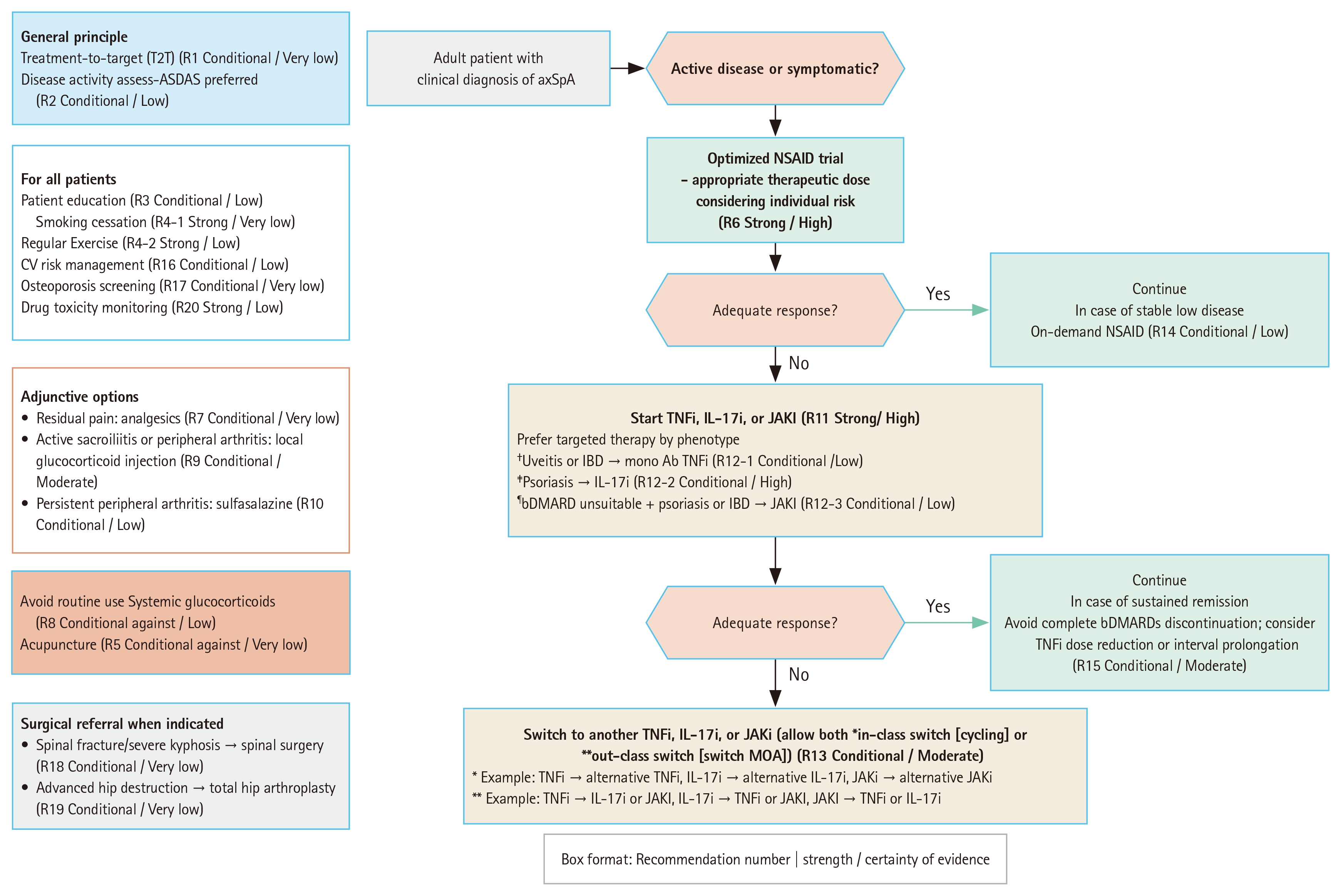
Algorithm based on the KCR recommendations for the management of axial spondyloarthritis (axSpA). axSpA, axial spondyloarthritis; NSAID, nonsteroidal anti-inflammatory drug; IA, intra-articular; TNFi, tumor necrosis factor inhibitor; IL-17i, interleukin-17 inhibitor; JAKi, janus kinase inhibitor; IBD, inflammatory bowel disease; bDMARD, biologic disease modifying antirheumatic drug; ASDAS, axial spondyloarthritis disease activity score; MOA, mode of action.
CONCLUSION
This updated Korean guideline provides comprehensive, evidence-based recommendations for the management of adult patients with axSpA, incorporating recent advances in diagnosis, disease monitoring, pharmacological and non-pharmacological treatment, safety surveillance, and surgical management. Since the publication of the previous Korean treatment recommendations in 2023 [2], substantial new evidence has emerged regarding bDMARDs, JAKis, treatment optimization strategies, and long-term safety considerations. The present update reflects these developments and aims to provide practical guidance applicable to contemporary clinical practice in Korea.
Compared with the 2023 Korean guideline [2], several important modifications have been introduced. First, greater emphasis has been placed on structured disease monitoring and individualized treatment decisions based on regular assessment of disease activity and treatment response. Although T2T strategies remain supported primarily by indirect evidence [3], accumulating data support the importance of continuous monitoring and timely treatment adjustment to achieve optimal clinical outcomes. Second, the therapeutic landscape has expanded considerably with increasing clinical experience and long-term safety data for IL-17is and JAKis [28–35,37–41,43,44,54,64–66,95–99]. Accordingly, the updated recommendations provide a more comprehensive framework for treatment escalation, switching, and optimization in patients with inadequate response to conventional therapy or biologic agents. Third, the current guideline places greater emphasis on safety monitoring, including screening and surveillance for infections, tuberculosis, hematologic abnormalities, hepatic toxicity, and malignancy during treatment with bDMARDs and JAKis. Finally, surgical management has been addressed in greater detail, with specific recommendations regarding THA for advanced hip involvement and spinal surgery for severe spinal deformity or unstable spinal fractures.
The updated recommendations are broadly consistent with recent ASAS-EULAR and ACR guidelines in their emphasis on regular disease activity assessment, non-pharmacological management including exercise, NSAIDs as first-line pharmacologic therapy, escalation to targeted therapies in patients with persistent disease activity, individualized treatment selection according to extra-articular manifestations, and tapering rather than abrupt discontinuation in patients with sustained remission. However, several distinctions reflect the Korean healthcare environment. In particular, greater attention is given to screening and monitoring for tuberculosis and infectious complications because of the epidemiologic characteristics of tuberculosis in East Asia. Furthermore, recommendations regarding treatment safety monitoring were developed as a distinct component of the guideline, reflecting the increasing use of advanced targeted therapies in routine clinical practice. Another notable feature of the present update is the incorporation of emerging evidence for newer targeted therapies. Unlike previous Korean recommendations and earlier ACR and ASAS-EULAR guidelines, the current guideline includes phase 3 evidence supporting the efficacy and safety of bimekizumab, a dual IL-17A and IL-17F inhibitor, thereby reflecting the expanding therapeutic landscape of axSpA [32]. In addition, the role of JAKis has been further refined based on accumulating clinical experience and long-term safety data [62,63]. An important update incorporated into the current guideline is the growing body of evidence supporting JAKis in axSpA. Beyond demonstrating efficacy in patients with inadequate response to previous biologic therapy, recent long-term safety analyses of upadacitinib have shown no new safety concerns over 5 years of follow-up [62]. Moreover, the development of extra-musculoskeletal manifestations, including uveitis, IBD, and psoriasis, was generally uncommon in upadacitinib user [62,63]. While TNFis and IL-17is remain the preferred targeted therapies in many patients, the guideline recognizes that JAKis may represent a reasonable alternative when bDMARDs are not appropriate or feasible, particularly in selected patients with concomitant psoriasis or IBD, where treatment decisions should be individualized according to disease phenotype and patient characteristics.
An important strength of this guideline is the rigorous methodology used during development. Recommendations were formulated through systematic literature review, evidence appraisal using the GRADE framework, and structured consensus among multidisciplinary experts and patient representatives. The guideline also reflects real-world clinical considerations relevant to Korean healthcare practice, thereby enhancing its applicability and feasibility. Furthermore, the inclusion of both pharmacological and non-pharmacological interventions, management of extra-articular manifestations and comorbidities, safety monitoring, and surgical treatment provides a comprehensive framework for patient care.
Several limitations should also be acknowledged. Despite extensive literature review, the certainty of evidence supporting many recommendations remained low or very low. This was particularly evident for recommendations regarding treatment tapering, surgical interventions, and safety monitoring, where randomized controlled trials are scarce and evidence is often derived from observational studies, expert consensus, or indirect comparisons. In addition, rapid advances in therapeutic options for axSpA may necessitate future revisions as new comparative effectiveness and long-term safety data become available. Finally, several clinically important questions remain unanswered, including optimal sequencing of targeted therapies, personalized treatment selection, and strategies for sustained remission.
This guideline is intended to assist healthcare professionals in making evidence-informed clinical decisions for the management of axSpA. It is not intended to replace the clinical judgment of individual physicians, establish a legal standard of care, or restrict clinical autonomy. Treatment decisions should be individualized according to each patient’s clinical condition, comorbidities, and preferences.
In conclusion, this updated Korean guideline provides contemporary recommendations for the management of axSpA across the full spectrum of disease care. The recommendations integrate recent advances in targeted therapies, emphasize patient-centered and multidisciplinary management, and address safety monitoring and surgical treatment in greater detail than previous versions. Although several recommendations remain supported by limited evidence, the guideline provides a practical framework for clinical decision-making and identifies important areas for future research.
Data availability
The data underpinning this article are available in the article itself, and in the online supplementary material.
Notes
Acknowledgments
The Korean College of Rheumatology financially supported the development of this guideline. However, these organizations did not affect the content of this guideline. The authors gratefully acknowledge Jae Hung Jung, MD, PhD, Professor in the Department of Precision Medicine/Urology and Director of the Institute of Evidence Based Medicine, Yonsei University Wonju College of Medicine, Coordinating Editor of the Korean Satellite of Cochrane Urology, and Co-director of the Korea GRADE Network, for his valuable advice and guidance regarding the GRADE methodology during the development of these clinical practice recommendations. The authors sincerely thank the members of the multidisciplinary External Review Committee, including primary care rheumatologists, specialists in rehabilitation medicine and pain medicine, a representative of the Korean College of Rheumatology Health Insurance Committee, and a patient representative from the Korean Ankylosing Spondylitis Association, for their valuable comments and constructive feedback, which helped improve the methodological quality, clinical relevance, and feasibility of this guideline. AI tool (Chatgpt) was used during manuscript preparation for language editing.
CRedit authorship contributions
Hong Ki Min: conceptualization, methodology, resources, investigation, data curation, formal analysis, validation, software, writing - original draft, writing - review & editing, visualization, supervision, project administration; Mi Ryoung Seo: conceptualization, methodology, resources, data curation; Sang-Hoon Lee: conceptualization, methodology, resources, investigation, data curation; Yeon-Ah Lee: conceptualization, methodology, resources, investigation, data curation; Jennifer Jooha Lee: conceptualization, methodology, resources, investigation, data curation; Seong-Ryul Kwon: conceptualization, validation; Tae-Hwan Kim: conceptualization, validation; Min-Chan Park: conceptualization, validation; Kichul Shin: conceptualization, validation; Ji Hyeon Ju: conceptualization, validation; Yong-Gil Kim: conceptualization, validation; Bon San Koo: conceptualization, validation; Eun Young Lee: conceptualization, validation; Hoon-Suk Cha: conceptualization, validation; Seung Cheol Shim: conceptualization, validation, writing - review & editing, supervision; Ji Hui Shin: validation; Tae Jong Kim: conceptualization, methodology, resources, investigation, data curation, formal analysis, validation, software, writing - original draft, writing - review & editing, visualization, supervision, project administration
Conflicts of interest
HK Min received unrestricted research grants from SK Chemical, and Jeil Pharmaceutical, and consulting and/or speaker fees from Janssen, Novartis, AbbVie, Samsung Bioepis, LG Chem, Pfizer, Viatris, and Eisai. SH Lee received consulting and/or speaker fees from Celltrion, AbbVie, Novartis, Pfizer, Hanlim Pharm, and Janssen. YA Lee received unrestricted research grants from Celltrion, and consulting and/or speaker fees from Lilly, LG Chem, AbbVie, Celltrion, and Janssen. Jennifer JH Lee received consulting and/or speaker fees from Lilly, Hanlim Pharm, AbbVie, Novartis, and Janssen. SR Kwon received unrestricted research grants from Celltrion, and consulting and/or speaker fees from Abb-Vie. K Shin received unrestricted research grants from Novartis, Abb-Vie, and Yuhan Corporation. JH Ju received consulting and/or speaker fees from Novartis. BS Koo received unrestricted research grants from Janssen, and consulting and/or speaker fees from Janssen, Novartis, AbbVie, Samsung Bioepis, Pfizer, Viatris, and Hanmi. EY Lee received consulting and/or speaker fees from Samsung Bioepis, Janssen, Novartis, Eisai, UCB, and AbbVie. HS Cha received unrestricted research grants from Celltrion, and consulting and/or speaker fees from LG Chem, Celltrion, and AbbVie. MC Park has been an editorial board member since June 2014, but has no role in the decision to publish this article. TJ Kim received consulting and/or speaker fees from AbbVie, Janssen, Novartis, UCB, and Samsung Bioepis. TJ Kim has been an editorial board member since May 2018, but has no role in the decision to publish this article. All other authors declare no competing interests.
Funding
None