Mortality risk associated with permanent central venous catheter use in the oldest-old population: a nationwide cohort study
Article information

Abstract
Background/Aims
Owing to aging-related factors, arteriovenous access (AV) is difficult to establish in older patients; central venous catheter (CVC) access is used instead. However, evidence on long-term outcomes of permanent vascular access types in the oldest-old adults (≥ 80 yr) is lacking. We aimed to compare mortality by vascular access type in older Korean patients undergoing hemodialysis.
Methods
This nationwide retrospective cohort study included 79,286 adult patients who initiated maintenance hemodialysis between 2012 and 2021, identified from the Korean National Health Insurance Service database. Patients were categorized by permanent vascular access type (AV fistula [AVF], AV graft [AVG], or CVC). Kaplan–Meier survival analysis and Cox proportional hazards models were used to assess mortality across vascular access types. Analyses were stratified by age group.
Results
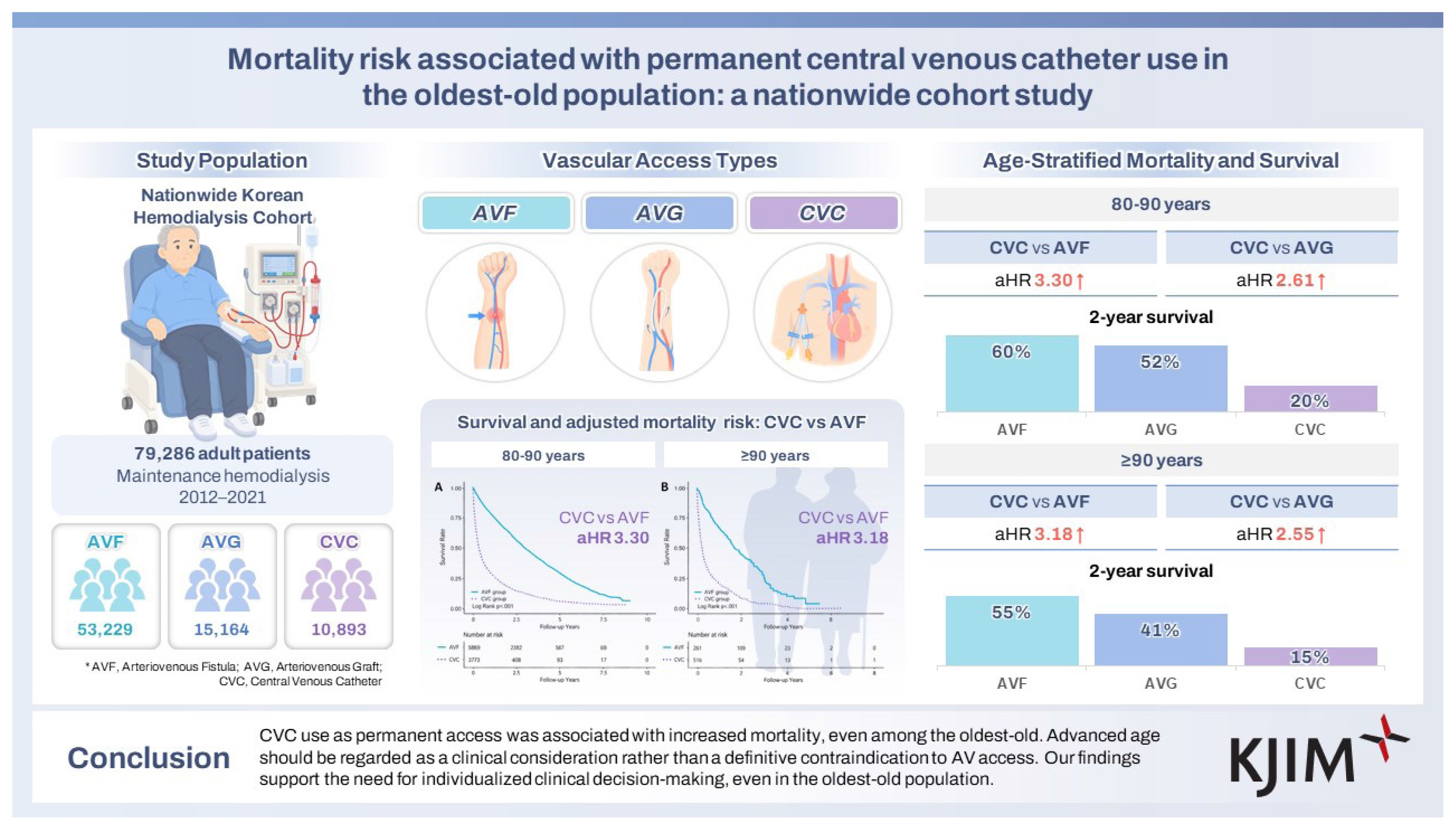
CVC access was associated with the highest mortality. Compared with AVF use, CVC use was associated with more than a threefold increase in mortality risk (aHR 3.54; 95% CI, 3.43–3.65). Though attenuated, the CVC use-associated mortality risk remained significantly elevated in octogenarians and nonagenarians (aHR 3.30; 95% CI, 3.14–3.47 and aHR 3.18; 95% CI, 2.65–3.82, respectively). Compared with AVG use, CVC use remained consistently associated with elevated mortality risk across age groups.
Conclusions
CVC use as permanent access was associated with increased mortality, even among the oldest-old. Advanced age should be regarded as a clinical consideration rather than a definitive contraindication to AV access. Our findings support the need for individualized clinical decision-making, even in the oldest-old population.
INTRODUCTION
With the significant increase in the global prevalence of end-stage kidney disease (ESKD) in recent decades, the age distribution of the patient population has shifted toward older adults [1–3]. Although hemodialysis is commonly selected for older patients [1,4], establishing and maintaining vascular access in this population remains challenging. According to the 2024 Korean Renal Data System report, patients with ESKD aged ≥ 65 years comprise 57.2% of the national dialysis population [4], underscoring the need for an appropriate vascular access method in this group.
Given the distinctive age-related physiological and clinical characteristics, personalized vascular access strategies are essential. The 2019 Kidney Disease Outcomes Quality Initiative (KDOQI) guidelines recommend patient-centered strategies, prioritizing arteriovenous access (AV; arteriovenous fistula [AVF] or graft [AVG]) over central venous catheter (CVC) access [5]. However, comorbidities, such as diabetes mellitus (DM) and peripheral vascular disease (PVD), often complicate AV access creation and hinder AVF maturation in older adults [2,6–8]. Many patients may die before the long-term survival benefits of AV access are realized [9–12]. Considering these clinical limitations, the KDOQI guidelines suggest long-term CVC use in certain circumstances. CVC access remains widely used and is often considered the most appropriate permanent alternative to AV access, especially in oldest-old adults [8,10,13,14]. Nonetheless, the appropriateness of long-term CVC use in this population remains controversial, given its well-established links to central venous stenosis, infection, and increased mortality [15–18].
As randomized controlled trials are not feasible owing to ethical and clinical constraints, we designed an observational study using real-world data from the National Health Insurance Service (NHIS) database, which provides comprehensive clinical and mortality information. We aimed to evaluate the long-term mortality risk associated with CVC use as permanent vascular access in older hemodialysis patients—particularly octogenarians (aged ≥ 80 yr) and nonagenarians (aged ≥ 90 yr)—using a large-scale national cohort.
METHODS
Data Sources
This retrospective cohort study was conducted using data from the Korean NHIS, a government-operated single-payer system that provides universal health coverage. The NHIS maintains a comprehensive database comprising demographic characteristics, International Classification of Disease, Tenth Revision (ICD-10) diagnosis codes, procedure codes, prescriptions, and healthcare utilization records [19].
Data collection and publication were performed in accordance with the relevant guidelines and regulations, and approved by the Institutional Review Board of Ewha Womans University Hospital, Seoul, Korea (No. EUMC 2023-03-040). Owing to the use of de-identified and routinely collected data, the requirement for informed consent was waived.
Participants
This study included adult patients aged ≥ 18 years who initiated maintenance hemodialysis between 1 January, 2012 and 31 December, 2021. The inclusion criteria were: (1) ESKD diagnosis (ICD-10 code: N18), (2) registration for maintenance dialysis (V001), or (3) receipt of outpatient hemodialysis procedures (O7020, O7021, or O9991) for ≥ 3 consecutive months.
The index date was defined as the first date of vascular access creation. The vascular access type was categorized as AV access—further subclassified as AVF (O2011, O2012, or O2081) or AVG (O2082)—and CVC (O7011–O7018).
Patients were classified into the following groups: (1) AVF: those with AVF as initial access or after CVC use; (2) AVG: those with AVG as initial access or after CVC use; and (3) CVC: those who remained catheter-dependent without subsequent AV access. Patients who underwent AVF and AVG creation on the same day were classified into the AVG group, assuming that graft placement was made following AVF failure.
Measurements and Variables
The primary exposure variable was the type of permanent vascular access used during maintenance hemodialysis (AVF, AVG, or CVC). Older age was defined as ≥ 65 years. Patients were further stratified into four age subgroups: 65–69, 70–79, 80–89, and ≥ 90 years, to allow a more detailed assessment of outcomes across the aging spectrum, particularly within the “young-old” population while maintaining adequate sample size within each age subgroup. This approach was informed by age-stratified analyses used in previous large cohort studies [20,21].
The baseline characteristics included age, sex, and comorbidities identified using ICD-10 codes: DM, hypertension, coronary artery disease (CAD), cerebrovascular accident (CVA), and PVD (see Supplementary Table 1 for code details). Data on intravenous antibiotic use (vancomycin, teicoplanin, and cefazolin) and catheter replacement were also collected. Analyses were stratified by sex and DM status.
Outcomes
The primary outcome was all-cause mortality. To minimize lead-time bias from delays between AV access surgery and hemodialysis initiation, survival time was measured from the date of hemodialysis initiation. Follow-up continued until death or censoring at the earliest occurrence of transition to peritoneal dialysis (procedure codes: O7061, O7062, O7071, and O7072), kidney transplantation (ICD-10 code: Z940), or the end of the study period (31 December, 2021). Supplementary analyses were conducted to assess complication-free survival, specifically focusing on catheter-related infections and dysfunction in the CVC group.
Statistical analysis
The baseline characteristics and demographics were summarized by vascular access type. Categorical and continuous variables were presented as frequencies with percentages and means, respectively. Differences were assessed using one-way analysis of variance and chi-square test for continuous and categorical variables, respectively.
Survival by vascular access type was analyzed using the Kaplan–Meier method, and comparisons, via the log-rank test [22]. Cox proportional hazards models were used to estimate mortality hazard ratio (HR) and confidence interval (CI) for CVC access, using AV access as reference [23]. Although the mortality risk was not perfectly proportional over time, the Kaplan–Meier survival curves remained separated during follow-up. Therefore, the Cox proportional hazards model was used to provide a summary estimate of the overall HR. This analysis was repeated with AVF and AVG as the reference. Multivariate models were adjusted for age, sex, DM status, and presence of hypertension, CAD, PVD, and CVA.
Survival analyses were conducted in each age subgroup to evaluate whether the association between the vascular access type and mortality differed by age. Additional subgroup analyses were performed to assess the effect of the vascular access type on mortality by age, sex, and DM status. To evaluate catheter-related complications, complication-free survival was analyzed using the Kaplan–Meier method, with death treated as censored data. All statistical analyses were performed using SAS version 9.4 (SAS Institute Inc., Cary, NC, USA).
RESULTS
Patient characteristics
Of 79,286 patients who initiated maintenance hemodialysis, over half (59.0%, n = 46,774) were aged ≥ 65 years, and 17.4% (n = 13,856) were aged ≥ 80 years (approximately 51% female). When categorized by the vascular access type, 53,229 (67.1%), 15,164 (19.1%), and 10,893 (13.7%) patients were in the AVF, AVG, and CVC groups, respectively. The CVC group had the highest mean age (73.98 ± 12.64 yr), proportion of female patients, and CAD and CVA prevalences, and the lowest prevalence of hypertension. The AVG group had the highest DM prevalence. The mean follow-up duration was 3.22 ± 2.32 years, and 33,873 (42.7%) deaths occurred (Table 1). CVC use increased with age (6.7%, 8.8%, 15.4%, 29.3%, and 53.6% at < 65, 65–69, 70–79, 80–89, and ≥ 90 yr, respectively).
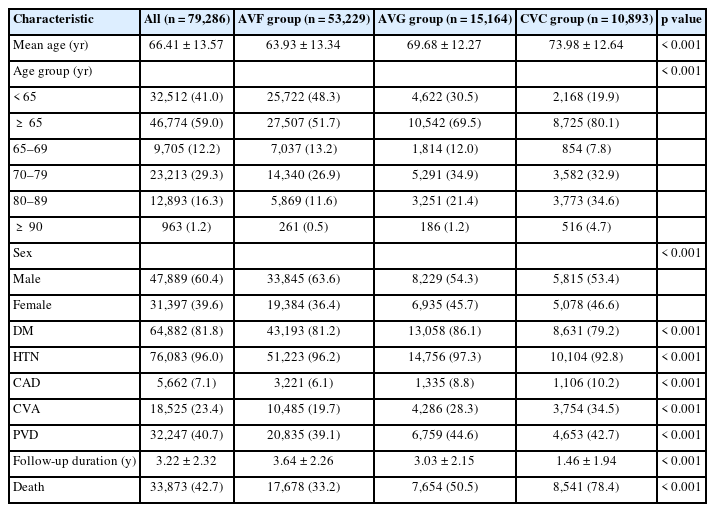
Baseline characteristics by vascular access type
Survival analysis
Kaplan–Meier analysis revealed consistently lower survival rates in the CVC group versus the AV group across age groups (Fig. 1). This pattern remained in all patients, including in octogenarians and nonagenarians, when the AV group was stratified into the AVF and AVG subgroups (Fig. 2). The survival curves remained separated throughout the follow-up.
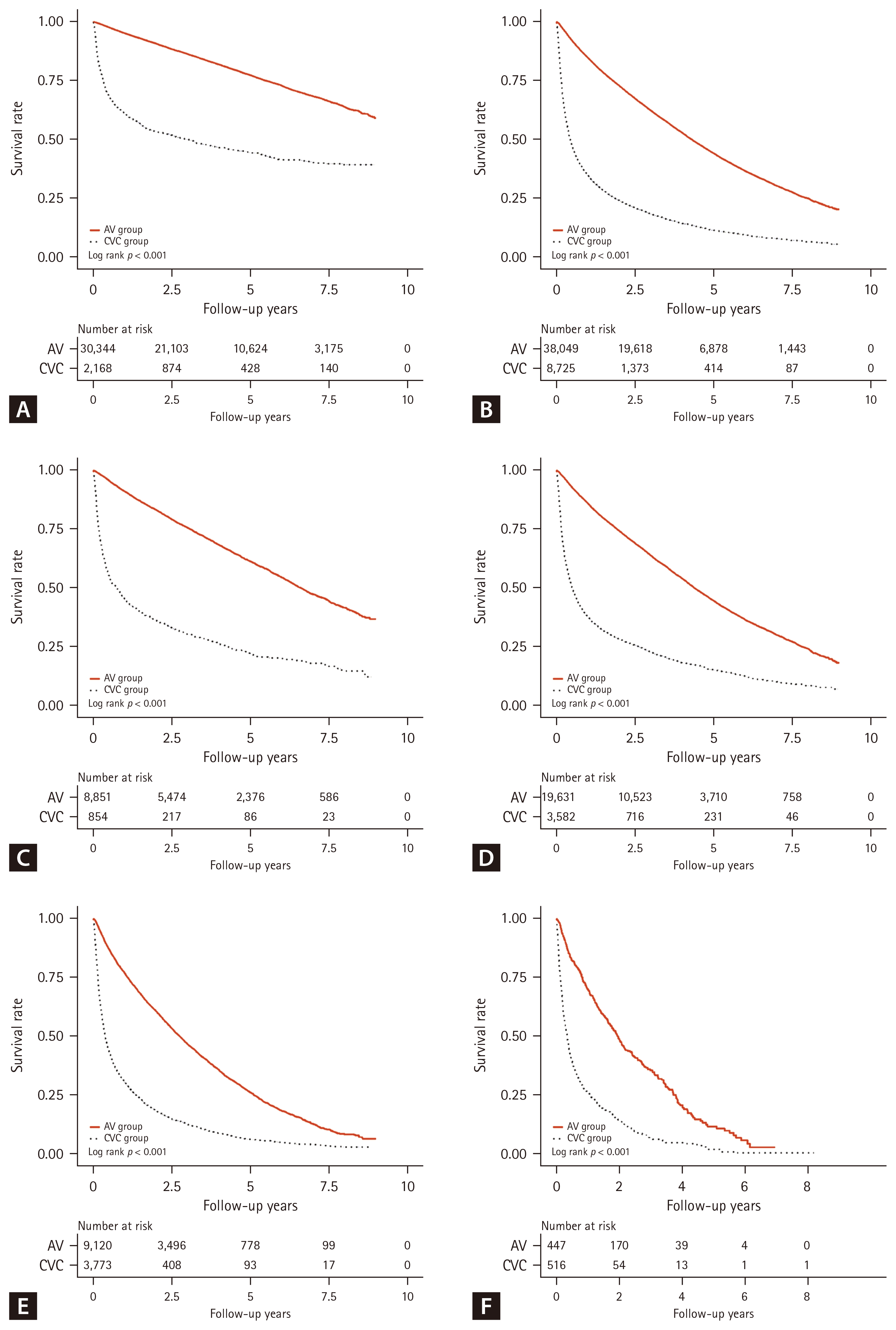
Kaplan–Meier survival curves stratified by the vascular access type for patients aged (A) < 65, (B) ≥ 65, (C) 65–69, (D) 70–79, (E) 80–89, and (F) ≥ 90 years. The AV group represents a combined cohort of patients in the AVF and AVG groups. AV, arteriovenous access; AVF, arteriovenous fistula; AVG, arteriovenous graft; CVC, central venous catheter.
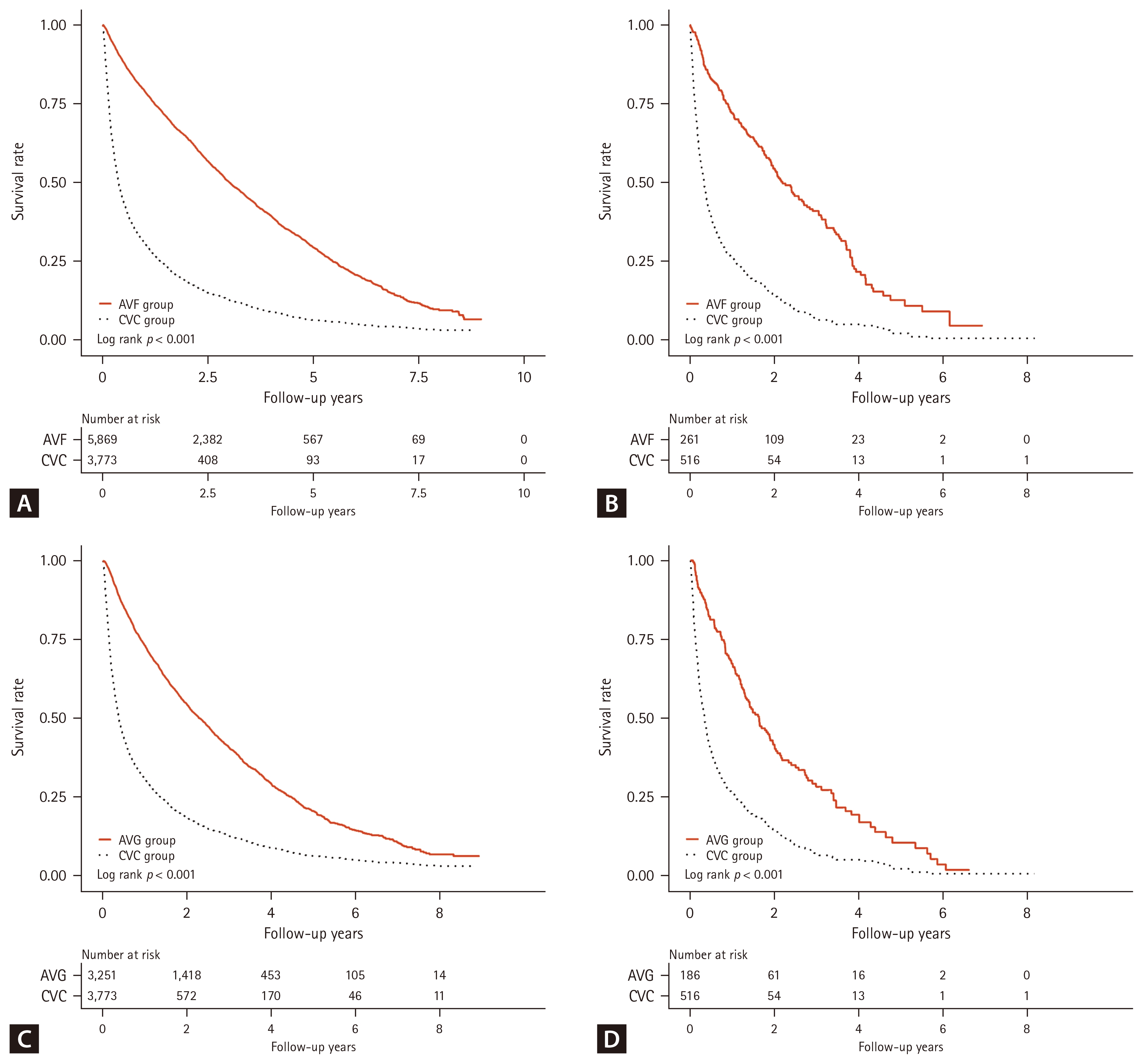
Kaplan–Meier survival curves of the patients aged (A) 80–89 and (B) ≥ 90 years in the CVC group versus the AVF group and those aged (C) 80–89 and (D) ≥ 90 years in the CVC group versus the AVG group. AVF, arteriovenous fistula; AVG, arteriovenous graft; CVC, central venous catheter.
Mortality risk associated with CVC use
In the overall cohort, CVC use was associated with a 3.4-fold increased risk of all-cause mortality, compared with AV access (adjusted hazard ratio [aHR] 3.41; 95% CI, 3.32–3.50; p < 0.001); this survival disadvantage remained robust even among nonagenarians (aHR 2.99; 95% CI, 2.57–3.47; p < 0.001). Although clinical covariates, such as sex, presence of hypertension, and DM status, showed varying degrees of association with mortality across age subgroups—including a paradoxically protective effect of hypertension in the 65–79-year age subgroup—CVC use remained associated with mortality in all multivariable models (Supplementary Table 2, 3).
Subgroup and access type comparisons
When AVF and AVG were used as separate reference groups, the CVC group consistently exhibited significantly higher mortality rates across age subgroups (all p < 0.001; Table 2). Compared with the AVF group, the CVC group demonstrated more than a threefold increased risk of mortality in all age subgroups; however, the HRs gradually declined with advancing age. In contrast, the survival benefit of AVG use over CVC use was less pronounced than that of AVF use over CVC use but remained relatively stable across the age subgroups. Regarding absolute survival measures, among octogenarians, the 2-year survival probability was approximately 60% and 52% in the AVF and AVG groups, respectively (versus 20% in the CVC group). Among nonagenarians, the corresponding survival rates were approximately 55% and 41% in the AVF and AVG groups, respectively (versus 15% in the CVC group). By 5 years, the survival rates among nonagenarians converged to approximately 10% and 8% in the AVF and AVG groups, respectively, while remaining markedly lower in the CVC group. Consequently, the AVF and AVG groups maintained a survival advantage over the CVC group in the long term, whereas the difference between the AVF and AVG groups reduced with advancing age.
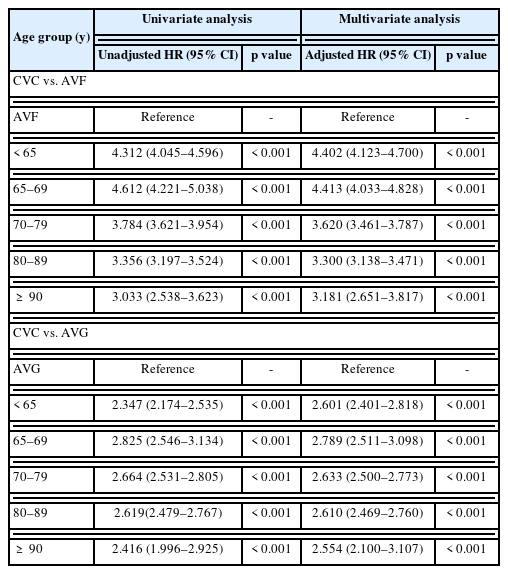
Mortality risk by age subgroup in the Cox models
Cox regression analyses stratified by age, DM status, and sex showed that CVC use remained associated with a high mortality risk across all subgroups. Even in the subgroup with the lowest relative risk—nonagenarian female patients with DM—CVC use remained associated with higher mortality, compared with AVF (aHR 2.61; 95% CI, 2.00–3.42) and AVG (aHR 2.41; 95% CI, 1.76–3.31). A sex-specific risk crossover occurred at the age of 70 years, where the relative risk became more pronounced in male patients than in female patients; apart from this, no other consistent trend or unidirectional pattern was observed across the strata (all p < 0.001; Table 3).
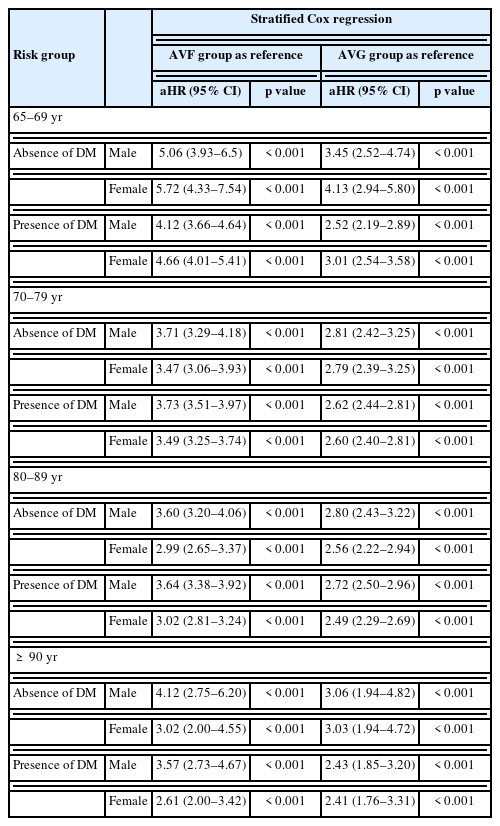
Mortality risk associated with CVC use across age, sex, and DM status in the stratified Cox models
Supplementary analysis
The incidence of catheter-related complications in the CVC group was highest during the first 3 months after dialysis initiation. The Kaplan–Meier curves showed a steep early increase in catheter-related infections and dysfunction within the initial period. Although the rate of incidence slowed significantly thereafter, complications continued to develop at a more gradual but persistent pace throughout the follow-up period, without reaching a complete plateau. This trend was consistently observed across all age subgroups (Fig. 3).
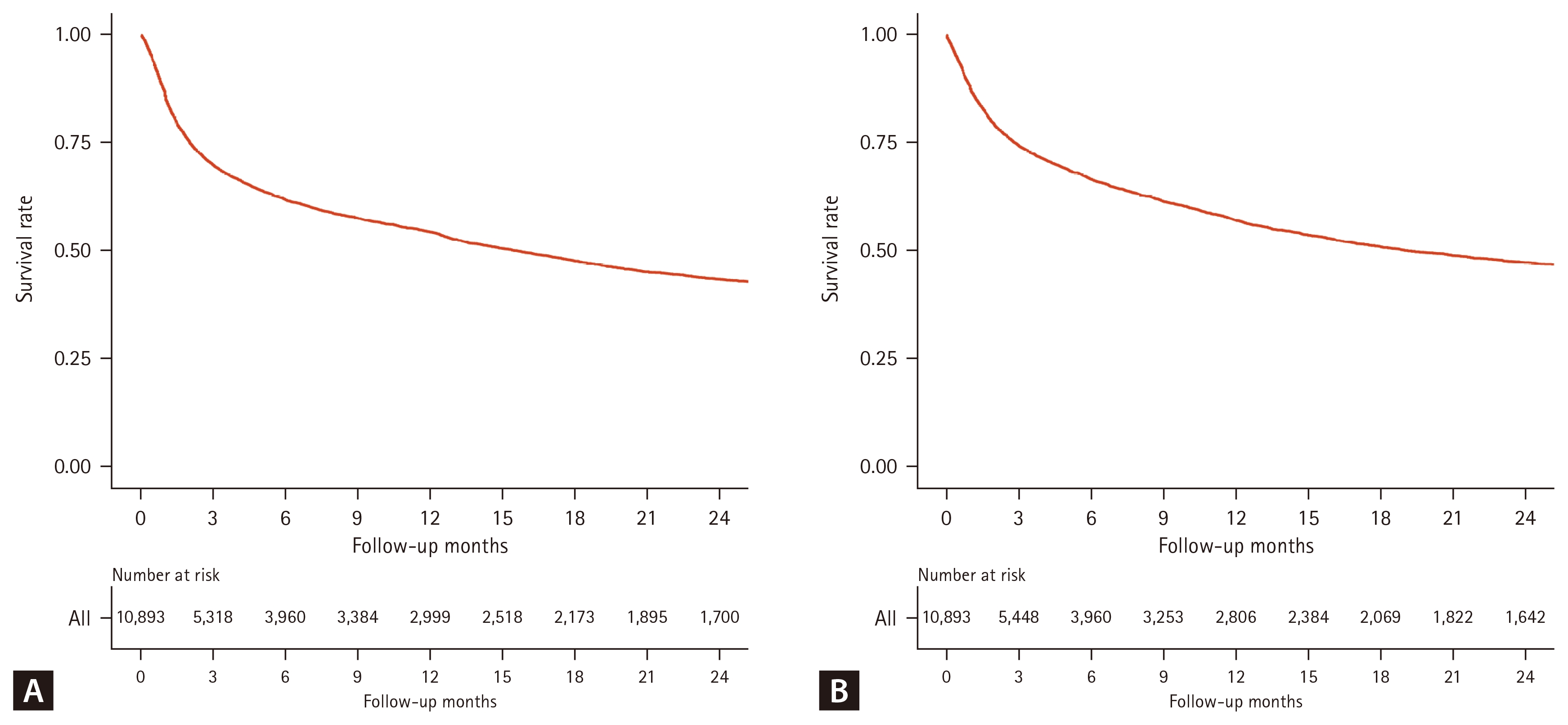
Kaplan–Meier curves for complication-free survival during maintenance hemodialysis. Time from the index date to (A) catheter-related infection and (B) to documented catheter dysfunction. Survival rate in this figure refers to the probability of remaining free from the specified complications.
DISCUSSION
In the present study, survival outcomes were evaluated in approximately 79,000 South Korean patients receiving maintenance hemodialysis using NHIS data with up to 10 years of follow-up. The patients were categorized by long-term vascular access type. Age-stratified analyses consistently showed higher mortality associated with CVC use versus AVF and AVG use. Specifically, the CVC group demonstrated more than threefold and twofold higher risk of mortality, compared with the AVF and AVG groups, respectively. These associations persisted after adjusting for age, sex, DM status, and the presence of hypertension, CAD, CVA, and PVD. To our knowledge, this is the first large-scale study on long-term survival outcomes by permanent vascular access type in patients undergoing hemodialysis across age groups, with specific age-stratified analyses of oldest-old individuals.
Current clinical guidelines recommend AVF as the preferred vascular access type for hemodialysis and discourage CVC use [5,24]. Numerous studies have shown higher mortality among patients initiating dialysis with CVCs versus AVFs [15,16,25,26]. However, findings from older populations are inconsistent. One study showed no significant mortality difference by the vascular access type in patients aged ≥ 65 years [27], whereas others suggested that CVCs are ideal for patients aged ≥ 80 years owing to technical challenges of AV access creation and limited life expectancy [8,13,14]. Nonetheless, most studies focused on the vascular access type at dialysis initiation rather than over long-term treatment course. Beyond the initiation phase, studies have assessed long-term outcomes. A study limited to patients on dialysis for at least 1 year showed a 3.43-fold higher mortality risk with CVC use versus AVF use, although only 5% of the patients used catheters [28]. Yeh et al. [29] followed up 738 patients undergoing hemodialysis aged 40–79 years for up to 10 years, categorizing them into three groups: AVF/AVG alone, AVF/AVG and catheters, and catheters alone. Compared with AVF/AVG use, the use of catheters alone was associated with a 3.23-fold higher mortality risk, whereas using both access types was associated with a 1.45-fold higher risk. Similarly, a 7-year observational cohort study conducted by Venegas-Ramírez et al. showed that tunneled CVC use was associated with a 2.38-fold increased mortality risk, compared with AVF use [30]. Our study builds on and extends this evidence by studying a large, nationally representative cohort with up to 10 years of follow-up. The findings showed that CVC use was associated with increased mortality risk, compared with AVF and AVG use, despite adjusting for demographic and clinical covariates. This association persisted among oldest-old individuals, including octogenarians and nonagenarians. Although previous studies have identified risks associated with catheter use at dialysis initiation [15,16,31], our study suggests that the association between CVC use and higher mortality was not limited to the initiation period but remained evident during long-term dialysis, including among the oldest-old individuals. These findings suggest that the association between AV access and more favorable survival may persist with advancing age and that AVF or AVG may remain a reasonable alternative to long-term catheter dependence when clinically feasible.
Patient-level factors, such as age, presence of cardiovascular disease, sex, and DM status, are well-established predictors of mortality in hemodialysis populations [32–34]. These associations were confirmed in our multivariable models, though attenuated in some age-stratified analyses. Notably, presence of hypertension was associated with decreased mortality, particularly in the 70–79-year group. This may reflect the phenomenon of reverse epidemiology, in which traditional cardiovascular risk factors are paradoxically associated with improved survival in patients on dialysis. Nonetheless, hypertension is well-recognized as a contributor to cardiovascular morbidity and mortality in the general population; thus, these findings should be interpreted cautiously [35,36].
The relationship between sex and mortality in hemodialysis remains controversial. Astor et al. reported that CVC use was associated with substantially higher mortality in male individuals (18.8% with CVC use vs. 10.2% with AVF use), with no effect in female individuals, and comparisons with AVG use yielded inconsistent results [27]. In contrast, in our study, CVC use was consistently associated with significantly higher mortality, compared with AVF and AVG use, in both sexes. Moreover, we observed an age-dependent reversal: female individuals demonstrated a higher CVC-associated mortality risk at < 70 years, whereas male individuals exhibited a higher risk at older ages. These discrepancies may not only indicate differences in sample size, racial composition, and study design but also suggest that vascular access outcomes are influenced by age and sex.
In the analyses stratified by age, sex, and DM status, the relative HR associated with CVC use was attenuated in certain subgroups but remained significantly elevated overall. For example, female nonagenarians with DM using CVCs exhibited more than a 2.4-fold increased mortality risk, compared with those using AVFs or AVGs. This contrasts with the findings of DeSilva et al. [26], regarding no significant survival advantage of AV use over CVC use among patients aged ≥ 90 years, though their small sample size (n = 280) possibly limited statistical power. In our study, CVC use remained significantly associated with higher mortality across age groups, despite adjusting for covariates.
Although catheter use is clearly associated with increased mortality in patients receiving hemodialysis, the underlying mechanisms remain complex and are likely multifaceted. Catheter-related infections [37–40] and dysfunction [41,42] are frequently cited as potential mechanisms which may increase infection risk or reduce dialysis adequacy [43,44]. In our study, these complications were most frequent during the first 3 months and continued to develop at a more gradual pace throughout the follow-up period, without reaching a complete plateau. This sustained occurrence might be partly explained by the observation that even a single episode of CVC-related infection can permanently elevate a patient’s baseline mortality risk, which never returns to the baseline level, even after clinical recovery [43]. However, the causal link remains a subject of debate. Notably, previous studies have paradoxically shown that, despite higher catheter dependency in the first 6 months after AVF creation, patients exhibit lower infection and mortality rates, compared with those with AVG access [9,45]. This inconsistency highlights the unclear causal link between catheter use and mortality. Therefore, our findings may reflect the cumulative risk associated with prolonged CVC exposure rather than a direct causal effect of catheter use itself. The differences in survival by the vascular access type may be driven, in part, by selection bias [20,39,46]. Notably, our AV access groups included patients who initially began dialysis with CVCs and later converted to AVF or AVG, which are typically associated with higher mortality [18,28,31,47]. Despite including these higher-risk converters in the AV group, the hazard associated with long-term catheter use remained substantially elevated. To partially mitigate the influence of acute illness at dialysis initiation, we included only the patients who survived and maintained dialysis for at least 3 months. However, because landmark analyses were not performed, the potential influence of early mortality and residual confounding related to underlying clinical conditions cannot be completely excluded. Therefore, although the observed mortality difference cannot be explained solely by patient selection, CVC use in this context may also reflect patients with poorer overall clinical condition. In this regard, catheter use may function not only as an exposure but also as a surrogate marker of higher illness severity. Accordingly, although patient preference, vascular status, comorbidity burden, and overall clinical condition are important determinants of vascular access choice, causality could not be definitively established in this observational study. However, the magnitude and consistency of the association between long-term catheter use and mortality across the age subgroups remain clinically meaningful.
This study focused on the risks associated with long-term CVC use and did not directly compare the survival outcomes between AVF and AVG use. In contrast to DeSilva et al. [21], who reported no significant survival difference between patients using AVF and AVG among those aged ≥ 80 years, our findings demonstrated a consistent survival advantage for patients using AVF across all age subgroups. However, the observed narrowing of this survival gap with advancing age and prolonged follow-up implies that the clinical superiority of AVF may become less pronounced in oldest-old individuals. Despite the statistical advantage of AVF identified in our cohort, the practical challenges associated with AVF in this population—specifically the high rates of maturation failure or delay (30–40%)—cannot be overlooked [48]. Given that the long-term survival benefit gap between AVF and AVG diminishes over time, prioritizing AVG to minimize the duration of CVC exposure may serve as a more pragmatic and reasonable primary alternative for oldest-old individuals, consistent with the strategies proposed in previous literature [21,48].
Ultimately, the discrepancy between our results and those of DeSilva et al. [21] underscores the complexity of vascular access selection in this heterogeneous population and highlights the urgent need for definitive evidence. As noted in a recent review [48], current knowledge is derived exclusively from observational data, and an ongoing randomized controlled trial [49] is investigating this question. Our findings regarding the convergence of survival benefits provide critical baseline data for such future trials and emphasize the importance of a patient-centered approach that balances statistical survival gains against the immediate risks of CVC-related complications.
This study has some limitations. First, given its retrospective nature, causality cannot be established. Second, the NHIS database lacks granular clinical details—such as laboratory results, specific anatomical information of the vascular access, and key indicators of a patient’s baseline status (e.g., insurance type, hospitalization history, and dialysis facility type). The absence of these variables, which reflect socioeconomic status, frailty, and healthcare utilization, prevented full adjustment for residual confounding and selection bias. Consequently, these unmeasured factors may have influenced the strength of the observed associations between the vascular access type and survival. Furthermore, although age was analyzed in the subgroup analyses to explore clinical trends, continuous modeling approaches— such as spline analysis to evaluate potential non-linear relationships between age and mortality—were not performed. Future studies using more granular data may help further clarify this relationship. Third, patient and physician decision-making, which are critical for vascular access selection, could not be captured from the data. Finally, as this study was conducted in a single-race population (Korean), generalizability to diverse populations may be limited.
Despite these limitations, this study has notable strengths. It included one of the largest cohorts to date of oldest-old patients undergoing hemodialysis, with age-stratified modelling to account for heterogeneity across age groups. The dataset used was derived from a reliable nationwide insurance claims system rather than from a single-center cohort. Furthermore, unlike previous studies that primarily focused on vascular access at dialysis initiation, this study evaluated the long-term use of various types of vascular access over a follow-up period of up to 10 years.
In this national cohort study, catheter use as permanent vascular access was associated with up to a five-fold higher risk of mortality, compared with the use of AVF or AVG. Despite adjusting for potential confounders, catheter use remained significantly associated with increased mortality in all age subgroups, including octogenarians and nonagenarians. Based on these findings, the use of CVC as a permanent vascular access should be carefully evaluated even in the oldest-old patients. Advanced age should be regarded as one of several clinical considerations rather than a definitive contraindication to AV access. Therefore, vascular access decisions should be individualized whenever clinically feasible.
KEY MESSAGE
1. In octogenarians and nonagenarians, permanent CVC use was associated with a two- to three-fold higher risk of mortality, compared with AV access.
2. Both AVF and AVG use were associated with better survival, compared with CVC use, suggesting AVG may represent a reasonable alternative for older patients.
3. Advanced age should be regarded as one of several clinical considerations, and individualized decision-making is essential.
Notes
Acknowledgments
The authors thank the National Health Insurance Service of Korea for providing access to the data used in this study.
CRedit authorship contributions
Joo Un Park: conceptualization, methodology, resources, investigation, data curation, writing - original draft, writing - review & editing; Chang Min Park: conceptualization, methodology, resources, investigation, data curation, formal analysis, validation; Do Hyoung Kim: conceptualization, methodology, resources, investigation, data curation, formal analysis, validation; Hyangkyoung Kim: conceptualization, methodology, resources, investigation, data curation; Byung Ha Chung: conceptualization, methodology, resources, investigation, data curation; Hyung Seok Lee: conceptualization, methodology, resources, investigation, data curation; Sang Jun Park: conceptualization, methodology, resources, investigation, data curation; Min-ho Kim: conceptualization, methodology, resources, investigation, data curation, formal analysis, validation, software; Hoon Suk Park: conceptualization, methodology, validation, writing - review & editing, supervision, project administration
Conflicts of interest
The authors disclose no conflicts.
Funding
This research was supported by a research grant of Korean society of dialysis access. The authors wish to acknowledge the financial support of the Catholic Medical Center Research Foundation made in the program year of 2017.